Your idea is safe; NDA signed before discussion
IoT Case Study

Smart Irrigation
Monitoring System

Efficient water management is becoming increasingly critical across agriculture, landscaping, and facility management. We built a smarter way to irrigate — powered by real-time sensor data.

  • Monitor soil moisture levels remotely
  • Automate irrigation cycles intelligently
  • Reduce water wastage significantly
  • Improve crop and plant health
Explore the Project
Smart Irrigation Monitor System
System Active · ESP32 Powered
40%
Water Saved
Real-time
Sensor Data
ESP32
Hardware Core
IoT
Remote Access
Overview

From Fixed Schedules to Intelligent Automation

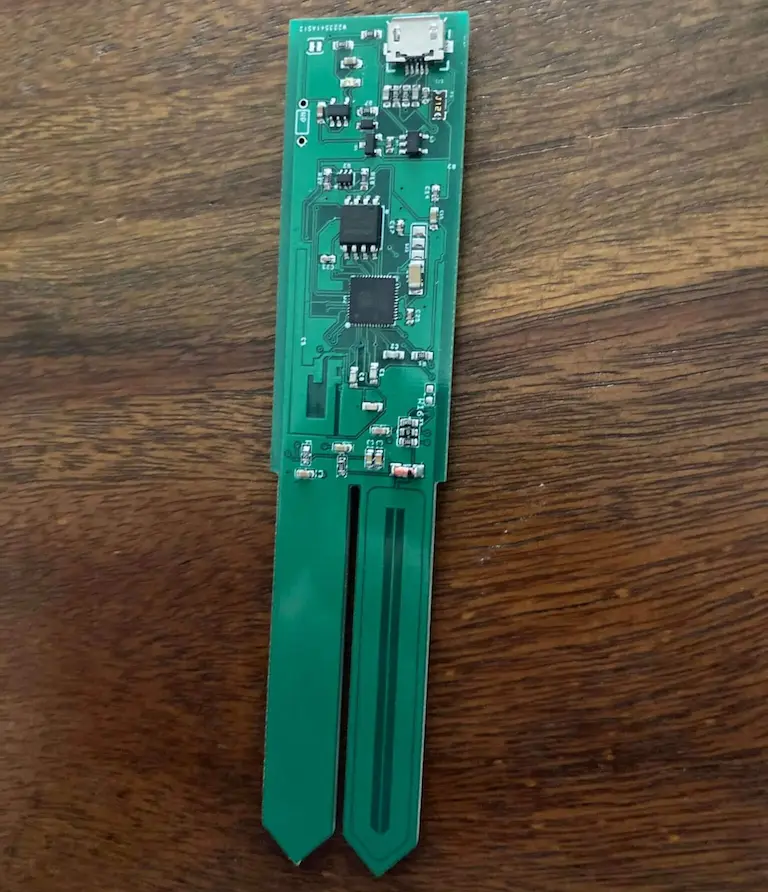
Traditional irrigation systems often rely on fixed schedules, leading to overwatering, wasted resources, and increased operational costs. To address this, we developed a smart irrigation monitoring system powered by ESP32, designed to automate watering decisions based on real-time environmental data.

More importantly, this project reflects how we approach real-world IoT system design — from hardware selection to scalable deployment.

Discover how DigitalMonk developed a Smart Irrigation Monitor using IoT technology for efficient, data-driven water management.
💧
Remote Soil Monitoring
Track moisture levels from anywhere via our IoT dashboard, eliminating guesswork in watering decisions.
⚙️
Automated Irrigation Cycles
ESP32-driven logic triggers watering only when soil conditions require it, not on a fixed timer.
📉
Reduced Water Wastage
Sensor-based scheduling prevents overwatering, cutting usage costs and environmental impact.
🌱
Healthier Crops & Plants
Consistent, precise hydration improves plant health outcomes across agriculture and landscaping use cases.
The Challenge

The Problem We Solved

Most irrigation setups leave users choosing between effort, cost, or accuracy — never all three. We changed that.

01
Manual Irrigation
Relies entirely on human judgment and availability. Labor-intensive schedules result in inconsistent watering and frequent over- or under-hydration.
Labor-Intensive & Inconsistent
02
Timer-Based Systems
Fixed schedules ignore actual soil and weather conditions. Water runs whether the soil needs it or not — wasting resources and money.
Not Responsive to Conditions
03
Industrial Solutions
Enterprise-grade systems are capable but priced far beyond what small to mid-scale agricultural or landscaping users can justify.
Not Viable for Smaller Scale
Client Requirements

What the Solution Had to Deliver

The client needed a system that worked in the real world — outdoors, always-on, and affordable. Four non-negotiables defined the brief:

  • 🌦️
    Outdoor Reliability
    Withstand weather, temperature swings, and field conditions without failure.
  • Minimal Power Consumption
    Designed to operate on low power — suited for remote or off-grid deployment.
  • 📡
    Real-Time Monitoring & Control
    Live soil data and remote override capability from any connected device.
  • 🗺️
    Multi-Location Scalability
    A single platform to oversee and manage irrigation across multiple sites.
Engineering Insight
Meeting all four requirements demanded a cost-effective yet powerful embedded system — one capable of handling sensors, wireless connectivity, and automation logic simultaneously, without the price tag of industrial alternatives.
The Gap We Identified
No off-the-shelf product bridged the gap between affordability and capability for this scale. That's exactly the space we built into.
Hardware Decision

Why We Chose ESP32

After evaluating multiple microcontrollers and embedded platforms, the ESP32 emerged as the clear choice — delivering the right balance of capability, connectivity, and cost for real-world field deployment.

ESP32
Wi-Fi · BLE
Chosen Platform
1
📶 Built-in Wi-Fi Connectivity
The ESP32 eliminates the need for external communication modules, reducing both hardware complexity and cost. Wireless capability is native — no shields, no extra wiring, no additional failure points.
2
Low Power Consumption
For field deployments — especially in agriculture — power efficiency is critical. ESP32 supports deep sleep modes, making it ideal for battery-powered or solar-powered systems where grid access isn't guaranteed.
3
🧠 High Processing Capability
Unlike basic microcontrollers, the ESP32 handles complex workloads simultaneously — no need for a separate processor or offloading logic to the cloud for every decision.
Sensor Data ProcessingEdge Decision-MakingCloud Communication
4
🗺️ Scalability
The same firmware architecture can be deployed across multiple devices and locations without major changes — making it straightforward to expand from a single site to a distributed network of nodes.
5
🛠️ Strong Ecosystem
A mature toolchain means faster development and confident long-term maintenance. ESP32 is supported by multiple frameworks — giving teams the flexibility to choose what fits their workflow best.
ESP-IDFArduinoRust ↗
The ESP32 wasn't chosen because it was familiar — it was chosen because it was the right tool for the exact constraints of this project: outdoor-grade, low-power, connected, and built to scale.
Our Verdict
Best-in-
class fit
Technical Design

System Architecture

The irrigation monitoring system was designed as a full-stack IoT solution — not just a sensor-based device. Hardware, firmware, and cloud work in concert to deliver a seamless experience.

System Stack — Top to Bottom
☁️Cloud &
Dashboard
Cloud PlatformReal-time DataHistorical TrendsThreshold ConfigManual Override
MQTT / HTTPS
💾Firmware
Layer
ESP32 FirmwareSensor PollingDecision LogicConnectivityPower Mgmt
GPIO / ADC / I²C
🔌Hardware
Layer
Physical ComponentsESP32Soil SensorsEnv. SensorsRelay ModulePower Unit
🔌
Hardware Components
Physical Layer
  • ESP32 Microcontroller — the processing and connectivity core
  • Soil Moisture Sensors — analog readings converted to soil saturation levels
  • Environmental Sensors — temperature and humidity monitoring
  • Relay Module — controls pump on/off based on firmware logic
  • Power Management Unit — supports battery and solar input sources
💾
Firmware Layer
Embedded Logic
  • Sensor Data Collection — continuous polling with configurable intervals
  • Threshold-Based Logic — triggers relay when moisture drops below set levels
  • Backend Communication — publishes data via MQTT or HTTPS to cloud
  • Power Optimization — deep sleep between cycles to extend battery life
☁️
Cloud & Dashboard
User Interface Layer
  • Real-Time Monitoring — live sensor feed visible from any device
  • Historical Trends — charts and logs for data-driven decisions
  • Threshold Configuration — users set moisture targets per zone
  • Manual Override — trigger or stop irrigation remotely at any time
End-to-End Data Flow
🌱
Sensors
Soil & Env. data
🧠
ESP32
Process & decide
☁️
Cloud
Store & publish
📊
Dashboard
Monitor & control
💧
Pump
Irrigate on demand
System Operation

How the System Works

A five-step loop — from sensing conditions in the field to controlling the pump remotely — runs continuously and autonomously once deployed.

Hybrid Approach
Edge Processing
+
Cloud Monitoring
Reliability + Flexibility
1
🌱Continuous Sensing
Soil moisture sensors and environmental sensors (temperature, humidity) measure field conditions continuously. Data is collected at configurable intervals without interruption.
2
🧠Local Processing on ESP32
Raw sensor readings are processed directly on the ESP32 — no round-trip to the cloud required for a decision. This keeps the system responsive even when connectivity is intermittent.
3
Threshold-Based Trigger
If moisture drops below a user-defined threshold, the firmware acts immediately — no human intervention needed.
💧
Auto-Trigger Event
Moisture below threshold → Relay activates → Pump starts irrigation
4
☁️Data Sent to Cloud Dashboard
Sensor readings, trigger events, and system status are transmitted to the cloud dashboard — giving users full visibility into what's happening in the field, in real time.
5
📱Remote Monitoring & Control
Users can monitor live data, review historical trends, adjust thresholds, and trigger or stop irrigation manually — from any device, from anywhere.
Design Philosophy
This hybrid approach — edge processing + cloud monitoring — ensures the pump responds instantly even offline, while users retain full visibility and control from anywhere.
Reliable offline
Flexible remotely
Capabilities

Key Features

Five carefully engineered capabilities that take the system from a simple sensor device to a complete irrigation management platform.

5
Core Features
🌿
Real-Time Soil Monitoring
Accurate, continuous tracking of soil moisture levels ensures plants receive the optimal amount of water — no more guessing or over-reliance on weather forecasts.
Live sensor feed · Continuous polling
⚙️
Automated Irrigation
The system eliminates guesswork entirely. Firmware logic evaluates moisture thresholds and triggers the pump automatically — with zero manual intervention required.
Threshold-based · Relay-controlled
📡
Remote Access
Users can monitor live readings, review logs, adjust thresholds, and manually trigger irrigation from any device, from any location — via the cloud-connected web dashboard.
Web dashboard · Any device, anywhere
🔋
Power Efficient Design
Firmware is optimized around the ESP32's deep sleep modes, dramatically extending operational life — making the system viable for battery-powered and solar-powered field deployments.
Deep sleep · Solar & battery ready
📊
Data-Driven Decisions
Historical sensor data is stored and visualised in the dashboard, empowering users to analyse trends, spot patterns, and continuously fine-tune their irrigation strategies over time.
Historical logs · Trend visualisation
🌿
Live
Soil Monitoring
⚙️
Auto
Irrigation Logic
📡
Remote
Web Access
🔋
Low
Power Draw
📊
Smart
Data Insights
Engineering Decisions

Challenges We Solved

Real-world IoT deployments are messy. Here's how we tackled the four hardest problems in building a system that works reliably in the field.

4
Engineering
Challenges
01
🌿
Sensor Reliability in Outdoor Conditions
Low-cost sensors often degrade over time. We built in resilience from the start.
Our Solutions
  • Calibration Mechanisms
    Firmware routinely recalibrates sensor baselines to account for drift and environmental shifts over time.
  • Error Handling in Firmware
    Out-of-range readings are flagged and filtered — preventing bad data from triggering false irrigation cycles.
  • Replaceable Sensor Design
    Hardware is modular — sensors can be swapped in the field without rewiring or reflashing the firmware.
02
📡
Network Stability
Outdoor deployments face unpredictable connectivity. The system must work regardless.
Our Solutions
  • Data Buffering
    When connectivity drops, sensor readings are stored locally on-device and synced to the cloud once reconnected.
  • Retry Mechanisms
    Failed transmissions are automatically reattempted with exponential back-off to avoid network flooding.
  • Offline Logic
    Irrigation automation runs entirely on the ESP32 edge — no internet connection required for the pump to fire.
03
🔋
Power Constraints
Remote areas can't rely on stable grid power. Every milliwatt matters.
Our Solutions
  • Deep Sleep Cycles
    The ESP32 enters deep sleep between readings, drawing near-zero current and dramatically extending battery life.
  • Efficient Wake-Up Triggers
    Timer-based and interrupt-driven wake-ups ensure the system activates only when a reading or action is needed.
  • Minimal Transmission Frequency
    Data is batched and sent at optimised intervals — reducing radio-on time, which is the biggest power draw.
04
🗺️
Scalability
The system had to grow from one field to many without rebuilding the architecture.
Our Solutions
  • Multi-Device Deployment
    Multiple ESP32 nodes can be deployed across fields, each operating independently and reporting to one platform.
  • Unified Dashboard
    All devices connect to a single cloud dashboard — giving operators a centralised view across every location.
  • Zero Re-Architecture
    New nodes are provisioned and registered without changes to the backend — plug in, configure, and go.
Engineering Philosophy
Every challenge above was anticipated at the design stage — not discovered in production. This is what systems thinking in IoT engineering looks like in practice.
Edge
Offline-First Logic
μW
Deep Sleep Draw
Nodes Supported
Extensibility

Use Cases Beyond Irrigation

While this system was purpose-built for irrigation, the underlying ESP32 architecture is industry-agnostic. The same sensor-edge-cloud pattern applies wherever real-time monitoring and automated response are needed — across agriculture, infrastructure, and environmental management.

Architecture Insight
The flexibility of ESP32 in building scalable IoT solutions means the firmware, cloud integration, and dashboard we built here can be adapted to entirely new domains with minimal redesign effort.
🌾
Smart Agriculture
Soil health tracking, crop microclimate monitoring, and automated input delivery across large-scale farming operations.
Agriculture
🏡
Greenhouse Monitoring
Precision temperature, humidity, and CO₂ control for enclosed growing environments — with automated ventilation and alerts.
Horticulture
🏭
Industrial Fluid Management
Flow rate, pressure, and tank level sensing in manufacturing or processing plants — with threshold-triggered valve control.
Industrial IoT
🏙️
Smart City Water Systems
Distributed leak detection, usage metering, and automated shutoffs across municipal water distribution networks.
Smart City
🌍
Environmental Monitoring
Air quality, water purity, and soil contamination sensing for conservation, compliance, or research deployments.
Environment
🔌
One architecture, many applications. The ESP32 + cloud + dashboard pattern we engineered here is a reusable blueprint — not a one-off build. Every new domain only requires updating the sensor layer and threshold logic.
5+
Industries Applicable
Our Process

Our Development Approach

This project reflects how our ESP32 development team approaches every embedded system build — from requirements through to production deployment. We don't just build prototypes. We build systems that are ready for the real world.

5
Stage Process
100%
Field-Ready Output
Edge
First Design
IoT
Specialist Team
🔍
1
Requirement Analysis
Understanding real-world constraints — environment, power, connectivity, scale — before a single line of code or component is chosen.
🔌
2
Hardware Selection
Choosing the right microcontroller, sensors, and peripherals based on the specific use case — not just what's cheapest or most familiar.
💾
3
Firmware Development
Writing optimised, production-grade firmware — with error handling, power management, and maintainability built in from day one.
☁️
4
Cloud Integration
Building scalable backend systems for real-time monitoring, data storage, and remote control — connected securely to every edge device.
5
Testing & Deployment
Validating reliability under real-world conditions — outdoor temperature, intermittent power, network instability — before handoff.
We don't just build prototypes — we build systems that are ready for deployment and scaling. Every decision in this project reflects that standard.
Deployment-Ready
Built to Scale
Production-Grade
Scalability

What Makes This Solution Scalable

A lot of IoT projects fail because they work only in controlled environments. This system was built with real deployment challenges in mind — from day one, not as an afterthought. It can grow from a single installation to a large-scale deployment without major redesign.

1 Node
10 Nodes
50 Nodes
100+ Nodes

Same architecture, no redesign required at any scale

🧩
Modular Architecture
Every layer — sensors, firmware, cloud, dashboard — is independently replaceable. Swap out a sensor type or migrate cloud providers without touching the rest of the stack.
Plug & replace
🩺
Remote Diagnostics
Each device reports its own health status — connectivity, battery level, sensor readings — to the dashboard. Issues are identified and resolved without a site visit.
Zero on-site debug
🔄
Firmware Update Support
OTA (Over-the-Air) firmware updates allow the entire device fleet to be patched, improved, or reconfigured remotely — no physical access to individual units required.
OTA enabled
🗂️
Multi-Device Management
The unified dashboard handles any number of ESP32 nodes across any number of locations. New devices self-register on first boot — no manual backend configuration needed.
Self-provisioning
The Scalability Promise
From one field to a hundred sites — the architecture holds. No rewrites, no re-engineering, no surprises.
OTA
Updates
Nodes
0
Redesigns
1
Dashboard
Security

Security Considerations

For any connected device, security is non-negotiable. A compromised irrigation system isn't just a data breach — it's a field that doesn't water, a crop that fails, or a pump that runs unchecked. We engineered protection in at every layer.

🛡️
EncryptedAuthenticatedAccess-Controlled
🔐
01
Secure Communication Protocols
All data in transit between the ESP32 and the cloud is encrypted — preventing interception or tampering even on public or shared networks.
  • TLS/SSL encryption on all MQTT and HTTPS traffic
  • Certificate-based device identity verification
  • Encrypted payload transmission end-to-end
🔑
02
Authentication Mechanisms
Only verified devices and users can communicate with the system. Unregistered nodes are rejected at the backend — ensuring no rogue device can inject data or commands.
  • Unique device tokens issued per ESP32 unit
  • User-level authentication on the dashboard
  • Token rotation and expiry policies enforced
🚦
03
Controlled Access to Commands
Actuation commands — pump on, pump off, threshold changes — are gated behind authorisation checks. No command reaches the hardware without explicit, validated permission.
  • Role-based access for operators vs. admins
  • Command signing to prevent replay attacks
  • Audit log of all remote actions taken
🛡️
Security was designed in — not bolted on. The system remains reliable and protected at any scale, from a single node in a backyard to hundreds of devices across distributed farmland.
TLS EncryptedZero Trust Ready
Results & Impact

What the System Achieved

Deployed in real conditions, the system delivered measurable improvements across every dimension the client cared about.

💧
Reduced Water Wastage
Sensor-driven irrigation eliminated unnecessary pump cycles, significantly cutting water consumption versus fixed-timer setups.
⚙️
Improved Irrigation Efficiency
Plants received water precisely when conditions required it — improving soil consistency and health outcomes across the field.
🙌
Lower Manual Intervention
Automation removed the need for daily field checks and manual pump operation — freeing up operator time for higher-value tasks.
📊
Better Field Visibility
The cloud dashboard gave the client real-time and historical insight into conditions across every zone — for the first time ever.
More importantly, we developed a repeatable IoT workflow. Working as an IoT product development company, we built architecture and firmware patterns that translate across projects with minimal rework, letting clients scale faster.
Ready to build something similar?
Work With Us

Looking to Build a Similar ESP32-Based System?

This irrigation monitoring system is just one example of what can be built using ESP32. Whether you're building an IoT product, a smart monitoring system, or an embedded automation solution — you need a team that understands both hardware constraints and software scalability.

  • IoT products & connected devices
  • Smart monitoring systems
  • Embedded automation solutions
Explore Our ESP32 Development Approach
DigitalMonk ESP32 Team
Hardware intuition.
Software discipline.
Production mindset.
  • End-to-end embedded system design
  • ESP32, ESP-IDF, Arduino & Rust firmware
  • Cloud-connected IoT architecture
  • Deployment-ready, not just prototype-ready
Hire an ESP32 Developer →
Final Thoughts

The right hardware choice is the
difference between a prototype
and a production system.

Selecting ESP32 for this project wasn't incidental — it was a deliberate decision made after evaluating the constraints. That decision unlocked everything that followed.

💰Cost-Effective Solution
📶Reliable Connectivity
🗺️Multi-Deployment Scale
Combined with a strong firmware architecture and a scalable cloud layer, selecting ESP32 enabled the creation of a robust, real-world IoT system — one that works in the field, not just on the bench. This is what thoughtful embedded system engineering looks like.
ESP32ESP-IDFArduinoRustMQTTHTTPSCloud DashboardOTA UpdatesDeep Sleep
DigitalMonk · ESP32 IoT Engineering
FAQs

Frequently Asked Questions

Everything you need to know about ESP32-based irrigation monitoring systems — answered clearly.

10
Questions
Answered
An ESP32-based irrigation monitoring system uses sensors and a microcontroller to track soil moisture and environmental conditions in real time. Based on this data, it can automatically control irrigation — reducing water wastage and improving efficiency without manual intervention.
ESP32 is widely used because it offers built-in Wi-Fi, low power consumption, and enough processing capability to handle real-time sensor data. It allows irrigation systems to be connected, automated, and remotely monitored without requiring additional hardware modules — keeping cost and complexity low.
Yes. ESP32 can be used in outdoor environments when paired with proper enclosures and power management systems. It is commonly deployed in agriculture, smart farming, and environmental monitoring solutions — and is designed to handle the demands of field conditions reliably.
The system collects soil moisture and environmental data through sensors. The ESP32 processes this data locally and triggers irrigation when moisture levels fall below a defined threshold. Data is also sent to a cloud dashboard, where users can monitor conditions and issue manual overrides remotely.
Yes, ESP32 is highly scalable. Multiple devices can be deployed across large fields, all connected to a centralised dashboard. With proper architecture, it supports both small farms and large agricultural operations — and new nodes can be added without re-engineering the system.
ESP32 provides a strong combination of features that make it ideal for IoT applications: Built-in Wi-Fi and Bluetooth connectivity, low power consumption with deep sleep support, cost efficiency compared to alternative platforms, strong ecosystem support — ESP-IDF, Arduino, Rust.
Yes. The system can operate fully offline using pre-defined thresholds and local decision logic on the ESP32 — the pump will still trigger automatically when needed. Internet connectivity is only required for remote monitoring, dashboard access, and manual control via the cloud interface.
Security depends heavily on implementation. A well-built ESP32 system includes TLS/SSL encrypted communication, unique device authentication tokens, role-based access controls, and audit logging for all remote commands. When designed correctly, it is robust enough for production deployments at scale.
Development timelines vary depending on complexity. A typical system — covering hardware integration, firmware development, cloud setup, and testing — can take anywhere from a few weeks to a few months. Systems with multi-device deployments, OTA update support, or custom dashboards naturally take longer.
If you're planning to build a similar solution, you can work with an experienced team that understands embedded systems, firmware, and IoT architecture end-to-end.

Hire an ESP32 Developer at DigitalMonk →
💬
Still have questions?
Our team is ready to discuss your project — from sensor selection to cloud deployment. No commitment, just clarity.
Talk to an ESP32 Expert →