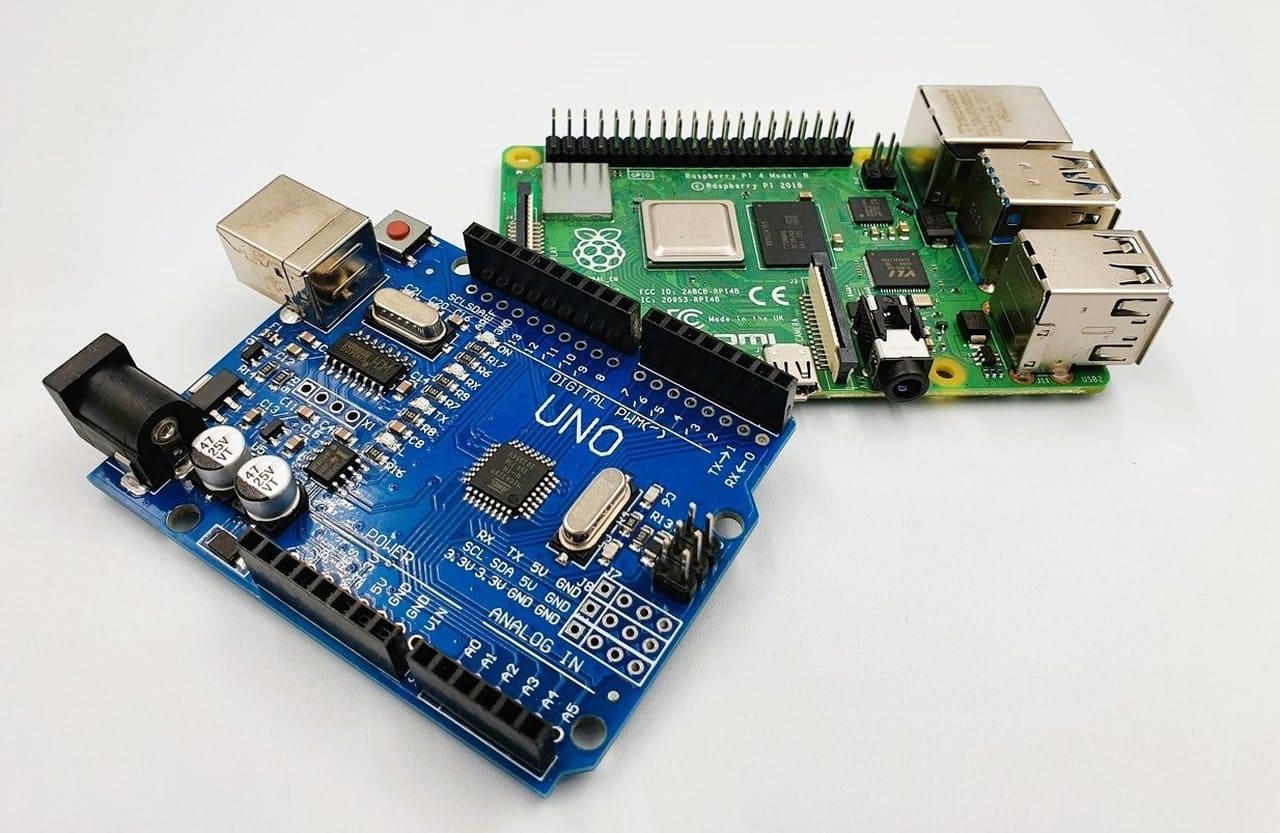
How to choose between Arduino & Raspberry Pi
Choosing between Arduino and Raspberry Pi is one of the most important decisions when building IoT products, robotics systems, automation devices, or smart electronics. Both platforms are powerful in their own domains, but they serve very different engineering purposes. Selecting the wrong one can lead to performance bottlenecks, power inefficiencies, or unnecessary complexity in your product architecture.
This comprehensive guide explains every factor you need to evaluate — from processing power and real-time control to scalability, cost, and real-world deployment — so you can confidently choose the right platform for your project.
Arduino vs Raspberry Pi: Core Concept Difference
Arduino = Microcontroller
- Executes a single program repeatedly
- Direct hardware interaction (sensors, relays, motors)
- No operating system
- Instant real-time response
Raspberry Pi = Mini Computer
- Runs Linux-based OS
- Supports GUI, web apps, AI models, and databases
- Multitasking & high-level programming
- Requires boot time and power management
📊 In simple words: Arduino controls hardware. Raspberry Pi processes data and runs software.
Key Factors to Consider Before Choosing
1. Project Type: Hardware Control vs Software Application
Choose Arduino if:
- You are building robotics or automation systems
- Need real-time sensor readings
- Motor control and embedded firmware required
- Low-latency and deterministic execution needed
Arduino is preferred for tasks that need precise real-time execution without OS interruptions.
Choose Raspberry Pi if:
- You want a smart IoT gateway
- Need camera, AI, UI, or networking
- Running web server, dashboard, or ML model
- Building edge-computing or smart-home hub
Raspberry Pi can handle multitasking and complex computation due to its powerful CPU and RAM.
2. Processing Power & Memory
| Feature | Arduino | Raspberry Pi |
|---|---|---|
| CPU | ~16 MHz | ~1+ GHz |
| RAM | Few KB | 1GB–8GB |
| OS | No | Linux-based |
| Multitasking | No | Yes |
Raspberry Pi has significantly higher computing power and memory, making it suitable for heavy workloads.
3. Power Consumption & Efficiency
If your product is battery-powered or always-on: Arduino wins.
- Consumes very low power
- Ideal for wearable & embedded systems
- Instant startup, no OS overhead
Raspberry Pi consumes more power and needs proper shutdown cycles like a computer.
4. Ease of Development & Learning Curve
Arduino
- Easier for beginners in electronics
- Uses simplified C/C++ environment
- Huge sensor ecosystem
Raspberry Pi
- Requires Linux familiarity
- Supports Python, C++, Node.js, etc.
- Suitable for software-heavy projects
Most comparisons highlight Arduino as beginner-friendly, while Raspberry Pi suits developers with software + OS experience.
5. Real-Time vs Multitasking Systems
This is the most critical decision point.
| Requirement | Best Choice |
|---|---|
| Real-time motor/sensor control | Arduino |
| AI, UI, and web processing | Raspberry Pi |
| Edge computing IoT hub | Raspberry Pi |
| Embedded firmware device | Arduino |
Because Arduino executes instructions directly without an OS, it offers deterministic real-time behavior that Raspberry Pi cannot guarantee.
Hybrid Architecture: Using Both Together
In many advanced commercial products, engineers combine Arduino and Raspberry Pi to leverage the strengths of both platforms.
In this hybrid architecture:
- Arduino handles real-time sensor control and hardware interaction
- Raspberry Pi manages data processing, networking, and UI
This separation improves reliability and scalability. For example, an IoT vending machine might use Arduino to control motors and payment hardware while Raspberry Pi manages the user interface and cloud analytics.
When designing such systems, businesses often prefer to hire esp32 developer resources to implement wireless microcontroller-based control layers, ensuring low-power connectivity alongside high-level processing units.
Similarly, complex products integrating firmware, drivers, and operating system components may require companies to hire embedded software engineer specialists who can architect both real-time and high-level software layers seamlessly.
Decision Framework: Quick Checklist
Use this decision tree to finalize your hardware strategy.
Choose Arduino if:
- You’re building robotics or industrial controllers
- Project requires deterministic timing
- Low-power embedded product
- Direct GPIO control needed
Choose Raspberry Pi if:
- Need GUI, camera, AI, or dashboard
- Cloud connectivity & edge analytics required
- Building smart kiosks or multimedia systems
- Complex software stack involved
Real-World Use Case Examples
Arduino-Based Projects
- Smart vending machine controllers
- Industrial automation boards
- Wearables and medical devices
- Sensor monitoring nodes
Raspberry Pi-Based Projects
- Smart home hubs
- AI surveillance systems
- IoT gateways & dashboards
- Edge computing devices
Cost Considerations
Cost plays an important role in hardware product development.
Arduino Boards
Generally cheaper and suitable for mass production in embedded devices. Their low-cost microcontroller design makes them ideal for large-scale deployments.
Raspberry Pi Boards
More expensive due to higher computing capability and components like RAM and storage interfaces. For high-volume manufacturing, this can significantly increase the product cost.
Therefore, Arduino is often used in final hardware products, while Raspberry Pi is commonly used in prototyping or as a high-level control unit.
Conclusion
There is no universal winner between Arduino and Raspberry Pi. Both platforms serve different engineering purposes and excel in their respective domains.
Arduino is the foundation of real-time embedded control, making it ideal for robotics, automation, and sensor-driven applications. Raspberry Pi is a powerful computing platform suited for AI, networking, dashboards, and high-level software processing.
By carefully analyzing your project’s hardware requirements, processing needs, power constraints, and scalability goals, you can select the platform that aligns perfectly with your product vision.
Frequently Asked Questions (FAQ)
Yes, a single RFID card can be mapped to a playlist or multiple songs.
Yes, songs can be updated easily through system configuration.
Absolutely. It is ideal for cafes, clubs, events, and public venues.
Yes, both the enclosure and RFID cards can be customized with branding. .