Turn Your Ideas Into Reality with Effective Prototype Development
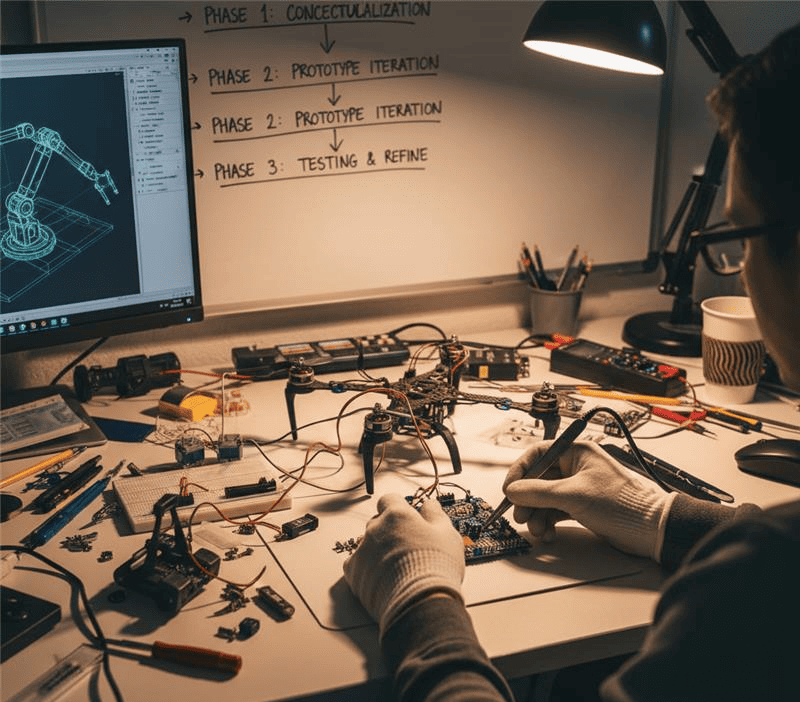
Turning an idea into a real, tangible product involves many steps—but none as critical as prototype development. Whether you’re building a software solution, an IoT device, or an embedded system, a well-executed prototype acts as your blueprint for success.
In this blog, we’ll explore everything you need to know about prototype development, including its methods, importance, and how DigitalMonk can help you accelerate your journey from concept to market.
🚀 Let’s Build Your Product Prototype — The Right Way
🎨 Creative & User-Centered Prototyping Techniques
Prototyping isn’t limited to digital tools or engineering models. Especially in early design stages, creative, low-cost techniques like sketches or role-playing can provide incredible insight into user experience and concept validation.
1. Sketches
Sketching is the most basic yet powerful way to visualize ideas quickly. Designers and developers use hand-drawn sketches to communicate layout, flow, features, or physical form of a product.
- Fast and low-cost
- Encourages creativity and exploration
- Easy to iterate or discard
- Great for early brainstorming sessions
Use case: Sketches are common in mobile app planning, website layout design, and hardware product shaping.
2. Paper Interface
A paper interface involves drawing the UI of an application or device on paper and simulating its interactions manually. It’s widely used in UX/UI prototyping before digital mockups.
- Inexpensive and quick to build
- Helps visualize user flow
- Useful for usability testing with end-users
Use case: Early-stage chatbot development. or AI dashboard interfaces often begin with paper interfaces to understand user pathways and logic flow.
3. Storyboard
A storyboard is a sequence of illustrations or imgs that show how a user might interact with a product in real life. It visually narrates the user journey and product’s role.
- Focuses on user context and emotions
- Helps identify use cases and pain points
- Useful for aligning teams on vision
Use case: Often used when designing Arcade game development Softwaresmart retail solutions, or interactive IoT interfaces where user engagement is key.
4. Role-Playing
This technique involves acting out how a user would use the product or system in a real-world scenario. It’s commonly used in service design and human-centered projects.
- Reveals emotional responses and user behavior
- Identifies real-life interaction issues
- Encourages empathy in design teams
Use case: For custom vending machines, teams may role-play a user buying a product to understand interaction timing, UI placement, and physical access.
5. User-Driven Prototypes
These are prototypes where the design evolves based on direct user input. Instead of presenting a pre-built model, users contribute ideas actively and iteratively shape the prototype.
- Directly aligns with user needs
- Promotes user satisfaction and product adoption
- Reduces assumption-based design
Use case: Often used in embedded software development services, for complex industrial or IoT applications where end-user workflow deeply affects system performance.
Bring IoT Ideas to Life with Expert Hardware Developers
Step-by-Step Prototype Development Process
Creating a prototype is a structured process. Here’s how it typically unfolds:
Requirement Gathering
Understand user needs, system functionality, and goals to create a blueprint.
Designing the Prototype
Create initial mock-ups, wireframes, or 3D designs depending on product type.
Prototype Creation
Build the prototype using hardware tools, software platforms, or 3D printing, depending on your product domain.
Testing and Feedback
Engage users, stakeholders, or internal QA teams to test usability, performance, and design accuracy.
Refinement
Make iterations based on feedback. With each loop, your prototype becomes more refined.
Why Is Prototype Development Crucial?
Investing in prototype development early saves cost, time, and effort in the long run. Here’s why it matters:
Validates Concepts Quickly
Improves Communication Across Teams
Identifies Technical Risks Early
Reduces Time-to-Market
Improves User Experience
Increases Investment Potential
For instance, in AI chatbot development services, a prototype chatbot allows real-time testing, interaction simulation, and NLP validation before launching a full-scale application.
Objectives Behind Building a Prototype
The purpose of developing a prototype goes beyond just a rough version of your product. It serves strategic functions like:
Verifying core functionalities and architecture
Attracting investors or early adopters
Enhancing product-market fit through real-world testing
Gathering technical data and usability metrics
Whether you’re working on a vending machine for gym or an IoT-based embedded product, prototyping is your risk mitigation tool.
How DigitalMonk Streamlines Your Prototype Development
At DigitalMonk, we combine innovation with execution. Whether it’s a web development service, IoT embedded software, or custom hardware solution, our team ensures your prototype delivers the insights and validation your business needs.
Verifying core functionalities and architecture
Attracting investors or early adopters
Enhancing product-market fit through real-world testing
Gathering technical data and usability metrics
We also offer services like Arcade game software, mobile app development, and chatbot development company solutions tailored to modern businesses.
Prototype for Every Industry
Your prototype strategy may vary depending on the industry:
Healthcare:
Functional prototypes for diagnostic devices or medical chatbots
Retail:
IoT-based machines like smart vending machines
EdTech:
Interactive web or mobile prototypes for better engagement
Automotive:
Embedded control prototypes for safety and automation
Understanding your niche ensures a smarter and leaner prototype development process.
Final Thoughts
In 2025, the healthcare landscape is shifting fast. Patients want instant answers, smart engagement, and digital convenience. If your clinic isn’t offering it, your competitors will.
By partnering with experienced teams like DigitalMonk, you ensure every prototype step aligns with your long-term vision and product roadmap.
Frequently Asked Questions (FAQ)
It depends on the complexity and fidelity. Low-fidelity ones can be built in days, while high-functioning versions may take weeks.
The cost depends on your machine’s complexity, features, and hardware requirements.
Yes! We build vending software that supports third-party integrations, including payment gateways, loyalty platforms, and mobile apps.
Yes, we provide end-to-end custom vending machine solutions, including prototyping, hardware selection, embedded software development, and cloud-based monitoring platforms.
Development timelines vary based on project complexity, prototyping, testing, and deployment.