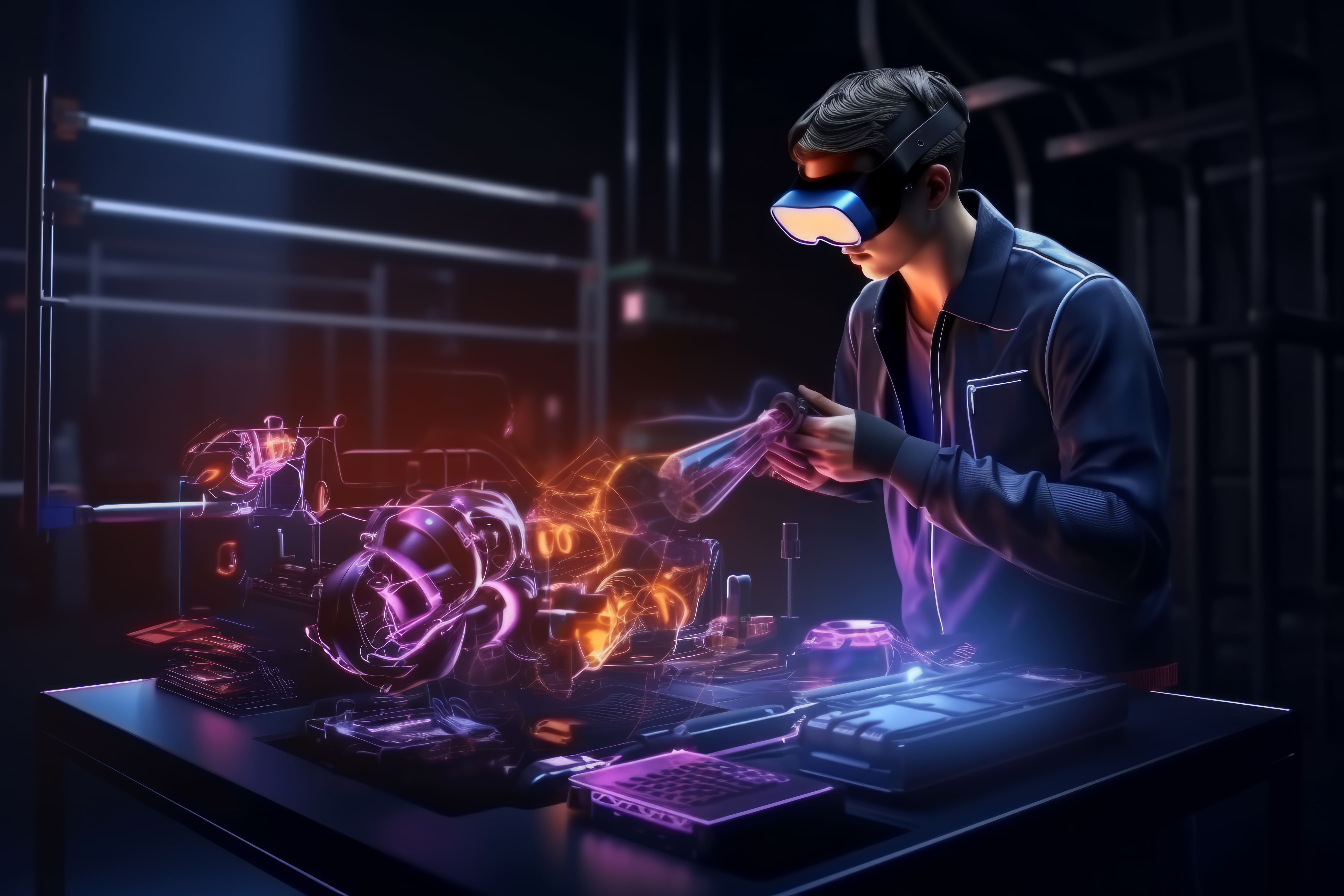
The Future of Embedded AI: From Microcontrollers to Machine Learning
AI is no longer confined to cloud servers or data centers; it’s quietly taking root inside the tiniest electronic components around us. From sensors in smart cities to the chips in wearable devices, embedded AI has begun to redefine what “intelligence” truly means.
This revolution is subtle yet powerful. Imagine a small microcontroller, the size of a coin—capable of learning human gestures, detecting faults in an engine, or distinguishing between cough types in a medical device. This isn’t science fiction anymore; it’s happening through a new class of technology that merges embedded systems with machine learning.
The future of embedded AI is about transforming simple machines into self-optimizing, decision-making entities systems that understand their environment and act on it intelligently without cloud dependency.
Why Embedded AI Is the Next Technological Leap
Until recently, AI applications demanded massive computational power GPUs, data centers, and terabytes of training data. But as industries sought faster and more energy-efficient intelligence, engineers began pushing AI models closer to the source of data: the edge.
By embedding AI into microcontrollers and IoT chips, companies are achieving three game-changing outcomes:
- Ultra-Low Latency— Decisions happen in milliseconds, essential for robotics and real-time automation.
- Data Privacy by Design : Sensitive data (like medical or industrial information) never leaves the device.
- Offline Intelligence – Firmware is critical for keeping smart devices secure. Regular firmware updates patch vulnerabilities, protecting against hacks and data breaches.
In other words, the intelligence is built in, not streamed in. According to MarketsandMarkets, the global market for Embedded AI is expected to reach $69.8 billion by 2028, growing at over 20% CAGR. This surge is fueled by the expanding adoption of edge devices across healthcare, automotive, industrial automation, and consumer electronics.
Build Smarter Solutions with expert IoT developers
How Microcontrollers Became Smarter Than Ever
Microcontrollers were once the “muscle” of machines, executing fixed commands written in C or assembly. But now, they’ve evolved into the “brains” of intelligent systems.
Thanks to TinyML (Tiny Machine Learning) frameworks, developers can compress deep learning models to run efficiently on hardware with less than 256 KB of RAM. Tools like TensorFlow Lite for Microcontrollers, Edge Impulse, and MicroTVM are democratizing embedded intelligence.
For example, the ARM Cortex-M series and Espressif’s ESP32 chips can now run models that recognize sound patterns, monitor machinery vibrations, or detect anomalies in temperature all on-device. This transition has made microcontrollers not just reactive but adaptive, capable of continuously learning from environmental data.
Where Embedded AI Is Transforming Industries
- Smart Manufacturing: Predictive Machines In Industry 4.0 environments, machines embedded with AI models are capable of predictive maintenance. Vibration and temperature sensors detect minute deviations that signal potential failures long before they happen.
Companies like Siemens and Bosch are embedding ML models into factory sensors to reduce downtime by up to 30%. It’s a real-world application of intelligence at the source of no cloud, no delay. - Healthcare: AI That Fits in Your Hand : The Internet of Things (IoT) thrives on seamless connectivity. Specialized IoT developers design sensor networks, data pipelines, and APIs that allow devices to communicate with each other and with cloud platforms.
- Smart homes rely on automation developers for HVAC, lighting, and energy management.
- Agriculture projects deploy IoT sensors for precision irrigation and soil monitoring.
- Industrial IoT enables predictive maintenance in factories, reducing downtime and costs.
This is where embedded software development services become vital—helping organizations build scalable IoT platforms with strong integration.
- Retail Automation: Intelligent Vending: Automation is the backbone of Industry 4.0. From robotic arms on assembly lines to AI chatbot development in customer service, automation reduces costs and boosts efficiency.
Specialized developers in automation:- Build firmware for robotic systems.
- Develop AI-powered controllers for smart factories.
- Implement edge computing for real-time decisions.
- Design chatbots and virtual assistants that streamline enterprise workflows.
Automation isn’t limited to factories—it extends to retail (smart vending machines), healthcare (AI-powered diagnostics), and logistics (automated warehouses).
- Automotive: Intelligence Under the Hood:Autonomous vehicles rely heavily on edge AI for object detection, route optimization, and safety systems. Tesla’s embedded neural processors handle tasks like lane recognition directly on the car’s hardware, reducing latency to milliseconds.
The combination of AI accelerators and real-time embedded systems has made modern vehicles computationally independent, capable of decision-making even in connectivity dead zones. - Consumer Devices: The Personalized Edge :From smart speakers that understand accents to earbuds that adapt sound profiles, Embedded AI is enhancing personalization. Devices are now designed to learn individual preferences, improving over time through localized inference rather than cloud data collection.
Ready to bring AI to Your Hardware?
The Hardware Race: Edge-Optimized Chips
Hardware innovation is at the heart of the embedded AI boom. Major semiconductor players are redesigning chips with AI acceleration cores optimized for low-power environments.
- NVIDIA Jetson Nano and Orin NX boards enable powerful edge inference in robotics.
- Google Coral Edge TPU specializes in real-time computer vision on small devices.
- Qualcomm’s Snapdragon AI Engine delivers embedded intelligence to mobile and automotive devices.
- STMicroelectronics’ STM32microcontrollers integrate lightweight neural network execution natively.
For rapid prototyping, companies often Hire Raspberry Pi Developer teams to simulate embedded AI models before porting them to production-grade hardware.
Embedded AI Meets the Cloud: Hybrid Intelligence
While the future is edge-driven, cloud integration still plays a vital role. Many industries are adopting hybrid AI architectures — training models in the cloud but deploying them on embedded devices for inference.
this strategy allows:
- Centralized learning from aggregated data
- Decentralized execution for real-time performance
- Seamless model updates across distributed devices
For example, a factory might train its machine learning model on massive cloud datasets but run that model locally in embedded controllers for precision automation. This blend ensures scalability and responsiveness — the best of both worlds.
Emerging Innovations in Embedded AI
The next phase of embedded AI will focus on efficiency, self-learning, and human-like adaptability. Here’s what’s shaping the landscape:
- . Federated and Continual Learning Devices will learn from their own usage data and update models independently, syncing improvements securely with central servers, without exposing raw data.
- Neuromorphic Computing: Inspired by biological neurons, chips like Intel’s Loihi 2 emulate brain-like behavior, performing AI tasks with 100x lower power consumption. Such architectures are tailor-made for embedded environments.
- . Cognitive IoT Networks : Embedded AI will power interconnected networks of smart nodes that collaborate, share context, and make collective decisions, the foundation of truly autonomous systems.
- Voice and Vision Integration:Embedded AI will increasingly intersect with AI chatbot development and computer vision, creating voice-driven, context-aware devices capable of both seeing and understanding their surroundings.
- Sustainable Intelligence :Future embedded systems will rely on energy harvesting using solar, kinetic, or thermal sources to power low-power AI models, making them both intelligent and environmentally responsible.
Embedded AI in Digital Transformation
For modern enterprises, Embedded AI is the cornerstone of digital transformation. It empowers organizations to bring intelligence closer to operations — enabling instant insights, automation, and predictive capabilities.
At DigitalMonk, our expertise spans embedded firmware, data intelligence, and Web Development Services that integrate these devices with smart dashboards and analytics layers.
We help businesses design, build, and deploy products that don’t just “connect” but think — from industrial IoT solutions to AI-driven retail experiences.
Why Embedded AI Will Define the Next Decade
We’re entering an era where intelligence will be as common in devices as electricity. AI will no longer be an add-on feature but a fundamental layer of embedded systems — powering everything from wearable sensors to aerospace control units.
The true future of Embedded AI lies not in replacing human intelligence but augmenting it — enabling machines to understand the physical world as intuitively as we do.
Companies that adopt Embedded AI today are not just keeping pace with innovation — they’re shaping it. Whether through smarter hardware, intelligent automation, or adaptive devices, the next frontier of computing is already here, running silently inside the smallest of chips.
Transform Your Ideas into intelligent Products?
Frequently Asked Questions (FAQ)
Machine learning in embedded systems enables devices to analyze data and adapt locally without cloud dependency.
Industries like automotive, healthcare, manufacturing, and smart IoT devices widely use embedded AI solutions.
Limited memory, power, and processing capabilities are key challenges in deploying AI on microcontrollers.
Embedded AI enables IoT devices to process data instantly, improving performance, privacy, and reliability.
The future of embedded AI lies in ultra-efficient chips, on-device learning, and smarter connected ecosystems.