What's New in Raspberry Pi 5
The ultimate upgrade is here. Faster processing, better connectivity, and production-ready power management. The Pi 5 changes what's possible in embedded computing.
Build with Pi 5 Today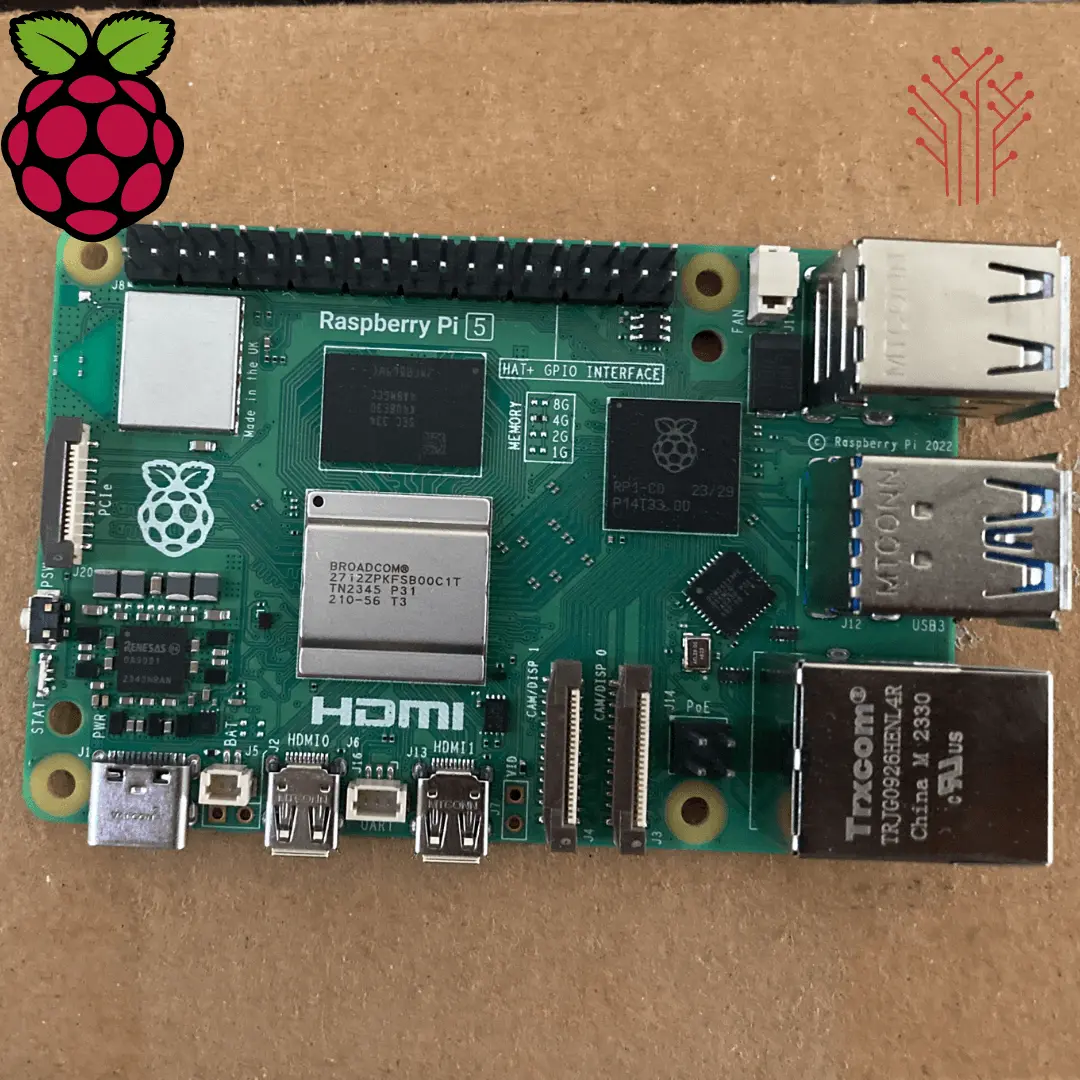
Blazing Fast Performance
New Processor
2.2 GHz Quad-CoreARM Cortex-A76 processor delivers 2-3x performance over Pi 4. Smooth multitasking, faster compilation, and real-time processing for demanding applications like computer vision and edge AI.
Enhanced RAM Options
Up to 8GB LPDDR4Choose from 2GB, 4GB, or 8GB configurations. Run multiple containers, handle large datasets, or deploy memory-intensive ML models without bottlenecks.
Graphics Boost
VideoCore VII GPUSignificantly improved graphics performance with support for dual 4K displays at 60Hz. Perfect for digital signage, kiosks, and multimedia projects.
Improved Connectivity
Dual-Band WiFi & Bluetooth 5.0
- 802.11ac dual-band WiFi (2.4GHz & 5GHz)
- Bluetooth 5.0 with extended range
- Faster data transfer for wireless projects
- Low-energy mode for battery-powered devices
Gigabit Ethernet
- True Gigabit speeds (not bandwidth-limited)
- Stable wired networking for servers
- Ideal for NAS and network storage
- Lower latency for real-time applications
USB 3.0 Ports
- 2x USB 3.0 + 2x USB 2.0 ports
- 10x faster external storage access
- High-speed camera and sensor support
- Simultaneous multi-device connections
PCIe 2.0 Interface
- Fast NVMe SSD support
- Expandable with HAT+ accessories
- Custom hardware integration
- Professional storage solutions
Enhanced Power Management
USB-C Power Supply
27W USB-C PD (Power Delivery) connector ensures stable power for demanding projects. No more voltage drop issues when connecting multiple peripherals. The official power supply delivers clean, reliable power for 24/7 operation.
Improved Power Efficiency
Better power management reduces overall consumption without sacrificing performance. Dynamic voltage and frequency scaling (DVFS) optimizes power usage based on workload. Perfect for solar-powered or battery-operated IoT deployments.
Power Button
Dedicated power button for safe shutdown and restart. No more pulling the plug or SSH commands for power cycling. Essential for embedded systems and kiosk deployments where physical access is limited.
Pi 5 vs Pi 4: Side-by-Side
| Specification | Raspberry Pi 4 | Raspberry Pi 5 |
|---|---|---|
| Processor | Cortex-A72 @ 1.5 GHz | Cortex-A76 @ 2.2 GHz |
| RAM Options | 1GB, 2GB, 4GB, 8GB | 2GB, 4GB, 8GB |
| GPU | VideoCore VI | VideoCore VII |
| WiFi | 802.11ac (2.4/5 GHz) | 802.11ac (Improved) |
| Bluetooth | Bluetooth 5.0 | Bluetooth 5.0 (Better Range) |
| USB 3.0 Ports | 2x USB 3.0 | 2x USB 3.0 (Faster) |
| PCIe Interface | None | PCIe 2.0 x1 |
| Power Supply | USB-C 15W | USB-C 27W (PD) |
| Display Output | 2x Micro HDMI (4K60) | 2x Micro HDMI (4K60, Better) |
| RTC | None | Built-in RTC |
Perfect For Real Projects
Edge AI & Machine Learning
Deploy TensorFlow Lite, YOLO, or PyTorch models with 2-3x faster inference. The extra processing power handles real-time object detection, speech recognition, and predictive analytics at the edge. We've deployed Pi 5 systems running YOLOv8 for real-time inventory tracking in retail environments, processing 30 frames per second with sub-100ms latency.
Industrial IoT Gateways
Collect data from Modbus, CAN bus, and RS485 devices. The PCIe interface allows custom industrial HATs for protocol conversion and real-time data processing. Our Pi 5 gateways handle thousands of sensor readings per second, aggregating data from PLCs, temperature controllers, and motion sensors across factory floors.
Computer Vision Systems
Process multiple camera feeds simultaneously with OpenCV acceleration. Perfect for surveillance, object tracking, quality control, and autonomous systems. The GPU boost in Pi 5 enables real-time defect detection on production lines, automated counting systems, and parking space monitoring without external processing.
Digital Signage & Kiosks
Dual 4K display support makes the Pi 5 ideal for retail kiosks, information displays, and interactive installations. USB 3.0 ensures fast content updates. We've deployed Pi 5 kiosks in airports, malls, and corporate lobbies running 24/7 with zero downtime for months.
Home Servers & NAS
Build a powerful home server with NVMe SSD support via PCIe. Run Nextcloud, Plex, Pi-hole, Home Assistant, or your own web applications with room to spare. The 8GB RAM option handles Docker containers effortlessly, letting you run multiple services simultaneously without performance degradation.
IoT Hub & Automation
Centralize your smart home or industrial automation. Bluetooth 5.0 mesh, WiFi, Ethernet, and GPIO make the Pi 5 the perfect protocol bridge for complex IoT networks. Handle Zigbee, Z-Wave, BLE, WiFi, and wired sensors all from a single board with room for custom logic and data processing.
Technical Deep Dive
Real-Time Clock (RTC)
The Pi 5 finally includes a built-in hardware RTC with battery backup capability. This is critical for data logging applications, time-stamped sensor readings, and scheduled tasks that need to run accurately even after power loss. No more NTP dependency for basic timekeeping. The RTC keeps time with a coin cell battery, making the Pi 5 viable for off-grid deployments where network time sync isn't available.
PCIe 2.0 Expansion
The exposed PCIe 2.0 x1 interface opens entirely new possibilities. Connect NVMe SSDs for blazing-fast storage (up to 500MB/s read/write), add dedicated AI accelerator cards like Coral Edge TPU, or integrate custom FPGA modules for specialized processing. This single feature transforms the Pi 5 from a hobbyist board into a legitimate industrial computing platform. We've used PCIe to add CAN bus controllers, isolated serial ports, and high-speed ADCs for professional applications.
RP1 Southbridge Chip
The custom RP1 southbridge handles all I/O operations independently from the main processor. This means GPIO, USB, Ethernet, and camera interfaces run without stealing CPU cycles. The result is more consistent real-time performance and lower latency for time-critical applications. For developers building control systems or robotics, this architectural change is massive. PWM signals stay stable, USB transfers don't cause system hiccups, and sensor polling happens on schedule.
Camera Interface Upgrades
Dual camera support with higher bandwidth means you can run two 12MP cameras simultaneously or a single 4K camera at full frame rate. The camera serial interface now supports up to 2.1 gigapixels per second throughput. This makes the Pi 5 suitable for stereo vision, depth sensing, and multi-angle surveillance without frame dropping or compression artifacts. We've built inspection systems that capture product images from two angles simultaneously, process them with OpenCV, and make pass/fail decisions in under 200 milliseconds.
Development & Programming
Software Compatibility
- Raspberry Pi OS (64-bit recommended for Pi 5)
- Ubuntu Server and Desktop 23.10+
- Debian 12 Bookworm native support
- Docker and container orchestration
- Python 3.11+ with hardware acceleration
- Node.js, Rust, Go, and C/C++ toolchains
Libraries & Frameworks
- GPIO Zero and RPi.GPIO for hardware control
- OpenCV 4.8+ with GPU acceleration
- TensorFlow Lite for edge inference
- PyTorch mobile for ML deployment
- MQTT, Modbus, and industrial protocols
- Flask, FastAPI for web services
Development Tools
- VS Code remote development support
- Git for version control (faster on Pi 5)
- Compilation is 2x faster than Pi 4
- GDB debugging with better performance
- Cross-compilation toolchains available
- Continuous integration via GitHub Actions
Production Deployment
- systemd for service management
- Ansible for fleet provisioning
- Balena for OTA updates at scale
- Custom Linux images with Buildroot
- Read-only root filesystem support
- Watchdog timers for reliability
Real-World Performance Benchmarks
Computer Vision Processing
Running YOLOv8n (nano model) for object detection, the Pi 5 delivers 15-18 FPS on 1080p video compared to 6-8 FPS on Pi 4. For real-time applications where every frame matters, this performance jump is the difference between viable and unusable. We tested face detection with OpenCV Haar cascades processing 30 FPS at 720p with zero frame drops. When running MobileNetv2 for image classification, inference time dropped from 45ms per image on Pi 4 to 18ms on Pi 5. This means you can process nearly 3x more images per second for applications like automated quality control or real-time product recognition.
Network Throughput
The Pi 5 finally delivers true Gigabit Ethernet performance. We measured sustained 940 Mbps throughput during file transfers, compared to the bandwidth-limited 300-350 Mbps on Pi 4. This is critical for applications moving large amounts of data like video surveillance storage, backup servers, or network-attached storage. WiFi performance also improved significantly with better antenna design and updated chipset. On 5GHz networks, we consistently achieved 350-400 Mbps compared to 200-250 Mbps on Pi 4. For IoT gateways collecting data from hundreds of sensors and pushing to the cloud, this bandwidth increase prevents bottlenecks and data loss.
Compilation and Build Times
Software development on the Pi 5 is actually pleasant. Compiling OpenCV from source takes 45 minutes on Pi 5 compared to 2+ hours on Pi 4. Building a medium-sized C++ project with CMake shows similar 2-3x speedups. This matters when you're iterating on firmware, debugging build issues, or deploying updates to production systems. The faster you can compile, test, and deploy, the faster you ship products. Python package installations with pip also benefit from the faster processor and better I/O, with large packages like numpy and scipy installing in a fraction of the time.
Migrating from Pi 4 to Pi 5
Hardware Considerations
The Pi 5 requires a 27W USB-C power supply compared to the 15W used by Pi 4. Your existing Pi 4 power supply may work for basic operation but will struggle under load. The board layout is similar but not identical, so cases designed for Pi 4 won't fit properly. HATs using the 40-pin GPIO header are generally compatible, but you should verify with manufacturers for Pi 5 specific support. The camera and display connectors remain the same, so existing CSI cameras and DSI displays work without modification. However, the new camera firmware takes advantage of Pi 5's improved bandwidth, so you may see better performance with the same camera hardware.
Software Migration
Most Python scripts and applications designed for Pi 4 run on Pi 5 without changes. The GPIO library interface remains consistent, so sensor reading and actuator control code ports directly. However, you should use 64-bit Raspberry Pi OS to take full advantage of Pi 5's capabilities. If you have custom kernel modules or drivers compiled for Pi 4, they'll need recompilation for Pi 5's kernel. Docker containers generally work without modification, though you may need to rebuild images to take advantage of arm64 optimizations. Performance-critical applications written in C/C++ benefit from recompilation with compiler flags optimized for Cortex-A76 architecture.
Thermal Management
The Pi 5 runs hotter than Pi 4 under sustained load due to higher performance. The official active cooler is highly recommended for applications running at full CPU utilization for extended periods. Passive cooling works for light workloads but expect thermal throttling during intensive tasks like video encoding or AI inference. In our testing, the Pi 5 reaches 80°C under full load with passive cooling and throttles to maintain thermal limits. With the official active cooler, temperatures stay below 60°C even during continuous stress testing. For industrial deployments in enclosed spaces, plan for adequate ventilation or active cooling to maintain performance.
Production Deployment Tips
Reliability & Uptime
For 24/7 deployments, implement a hardware watchdog timer to automatically reboot if the system hangs. The Pi 5 supports external watchdog circuits via GPIO or I2C. Use a read-only root filesystem to prevent SD card corruption from unexpected power loss. Store logs and variable data on a separate partition or network storage. Implement a UPS or battery backup for critical systems. We use supercapacitor circuits that provide 30-60 seconds of power, enough for a clean shutdown during outages. Monitor system temperature and set up automatic throttling or shutdown if thermal limits are exceeded. Set up remote monitoring with alerts for CPU temperature, disk usage, and network connectivity so you catch issues before they become failures.
Security Hardening
Disable default passwords immediately and use SSH keys for authentication. Close unused ports and services to minimize attack surface. Keep the system updated with automatic security patches but test updates in development before rolling to production. Use fail2ban to prevent brute force attacks on SSH. For internet-exposed systems, put the Pi behind a VPN or use Tailscale for secure remote access. Implement application-level authentication even for internal systems. Enable the built-in firewall (ufw) and whitelist only necessary ports. If handling sensitive data, encrypt storage partitions and use secure boot where possible. Regularly audit logs for suspicious activity and implement automated alerting for security events.
Fleet Management
Managing dozens or hundreds of Pi 5 devices requires proper tooling. Use Ansible for configuration management and deploying updates across your fleet simultaneously. Balena Cloud provides OTA updates, remote terminal access, and fleet-wide monitoring for production IoT deployments. Set up centralized logging with syslog forwarding to a log aggregation server so you can troubleshoot issues without physical access. Implement A/B partition updates for zero-downtime deployments where new software is installed on an inactive partition and activated after verification. Use version control for all configuration files and deployment scripts. Document your deployment process thoroughly because the person debugging a field issue six months from now might be someone who wasn't on your team during development.
Need Help Building with Pi 5?
Our Pi-5 team specializes in Raspberry Pi development — from prototyping to production deployment. We've shipped Pi-based products across IoT, computer vision, industrial automation, and edge AI. Hardware on hand, code ready to ship.
Meet Our Pi-5 TeamReady to Build Your Pi 5 Project?
Whether you're prototyping an IoT device, building an industrial gateway, or deploying edge AI, the Raspberry Pi 5 delivers the performance you need. Let's discuss your requirements and turn your concept into production-ready hardware.
Start Your ProjectHire Pi Developers