Custom Air Quality Monitor: An ESP32-C3 Case Study
How we took an indoor air quality device from concept to working, manufacturable hardware in under three weeks.
Build your IoT product →

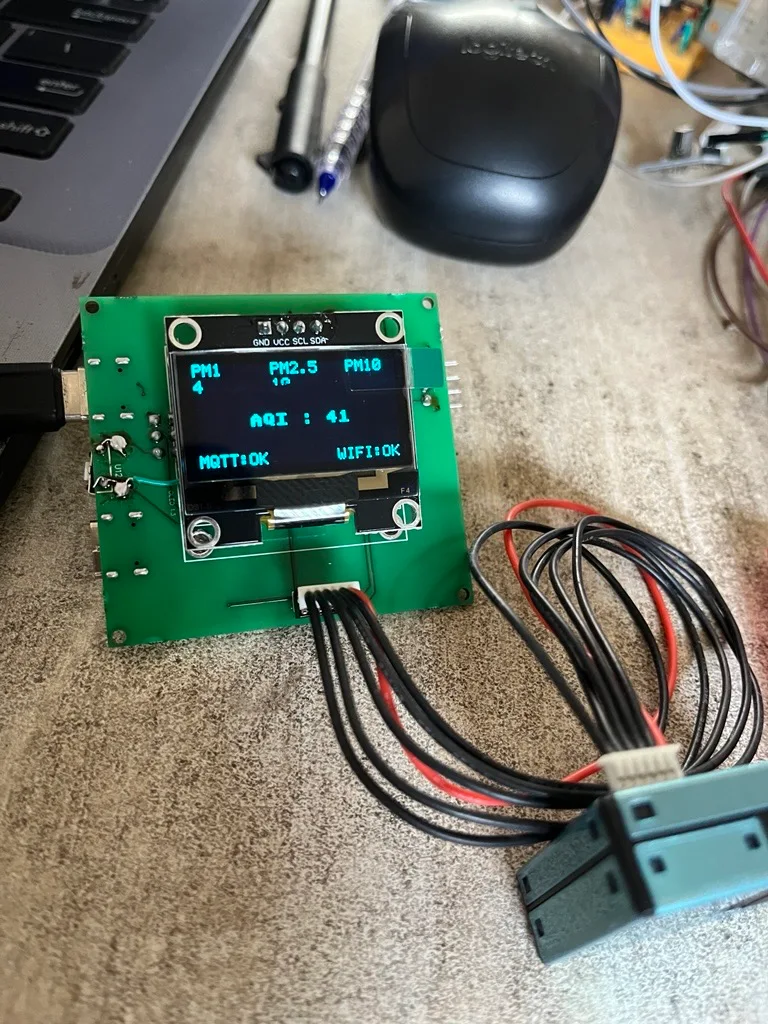
Project Overview
An indoor air quality monitoring company came to us with a straightforward ask: design and build their own branded AQI device — hardware, firmware, and cloud connectivity — that they could manufacture and sell under their own name. Not a rebranded module. Not a proof of concept destined for a shelf. A real product.
The Challenge
The client wanted their own air quality monitor — not a rebranded off-the-shelf unit with someone else's firmware and a sticker change. They needed hardware ownership: their brand on the device, their data on their servers, and full control over the product roadmap going forward.
Off-the-shelf devices didn't fit the brief. Commercially available AQI monitors either carry another manufacturer's branding or lock data into a vendor's ecosystem. At any meaningful production volume, the per-unit cost also reflects that manufacturer's margin — not an economics you want when you're selling the product yourself.
The requirements were clear:
- ◆Accurate PM1, PM2.5, and PM10 particulate measurement
- ◆Live on-device OLED display showing current readings and AQI
- ◆WiFi connectivity with MQTT publishing to their cloud
- ◆USB-C power — clean, modern, no proprietary connectors
- ◆A manufacturable PCB design, not a dev-board mashup
- ◆Working units fast — weeks, not a six-month development cycle
The challenge for our team was familiar: make every design decision earn its place. Component selection had to balance cost, availability, and capability. The PCB had to be clean enough to hand to a fabricator without revision. And everything had to work reliably in real environments — including outdoor deployments in high temperatures.
The Solution: Hardware Design
Choosing the ESP32-C3
This device only needed WiFi — no BLE mesh, no Thread, no long-range radio. The ESP32-C3 is built for exactly this use case: a single-core RISC-V processor with integrated WiFi and BLE, in a compact, low-cost package. Our ESP32 developers have shipped multiple products on this family, so there was no learning-curve overhead. The silicon cost is well-suited to volume production, and the toolchain — ESP-IDF — is mature.
For a connected air quality monitor publishing readings every 30–60 seconds, the ESP32-C3 has more than enough headroom. The RISC-V core handles sensor parsing, AQI calculation, OLED rendering, and WiFi/MQTT concurrently without any resource pressure. For a broader look at when an ESP32-class MCU is the right choice versus a Linux SBC, our ESP32 vs Raspberry Pi comparison covers the decision framework.
Plantower PMS-Series Particulate Sensor
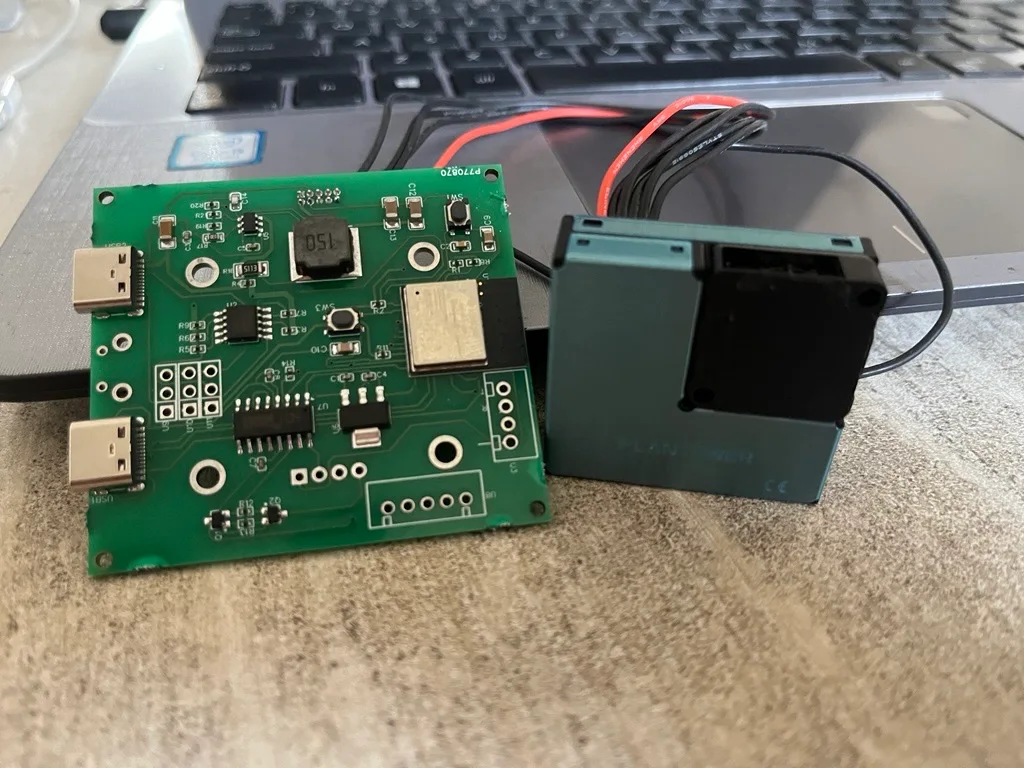
For PM sensing, we selected the Plantower PMS-series laser particulate sensor. It uses laser scattering to measure PM1, PM2.5, and PM10 simultaneously, communicates over UART, and has an established track record in commercial air quality equipment. The data output is structured, well-documented, and easy to integrate. It also runs from 5 V, which our power management circuit handles cleanly.
Custom PCB Design
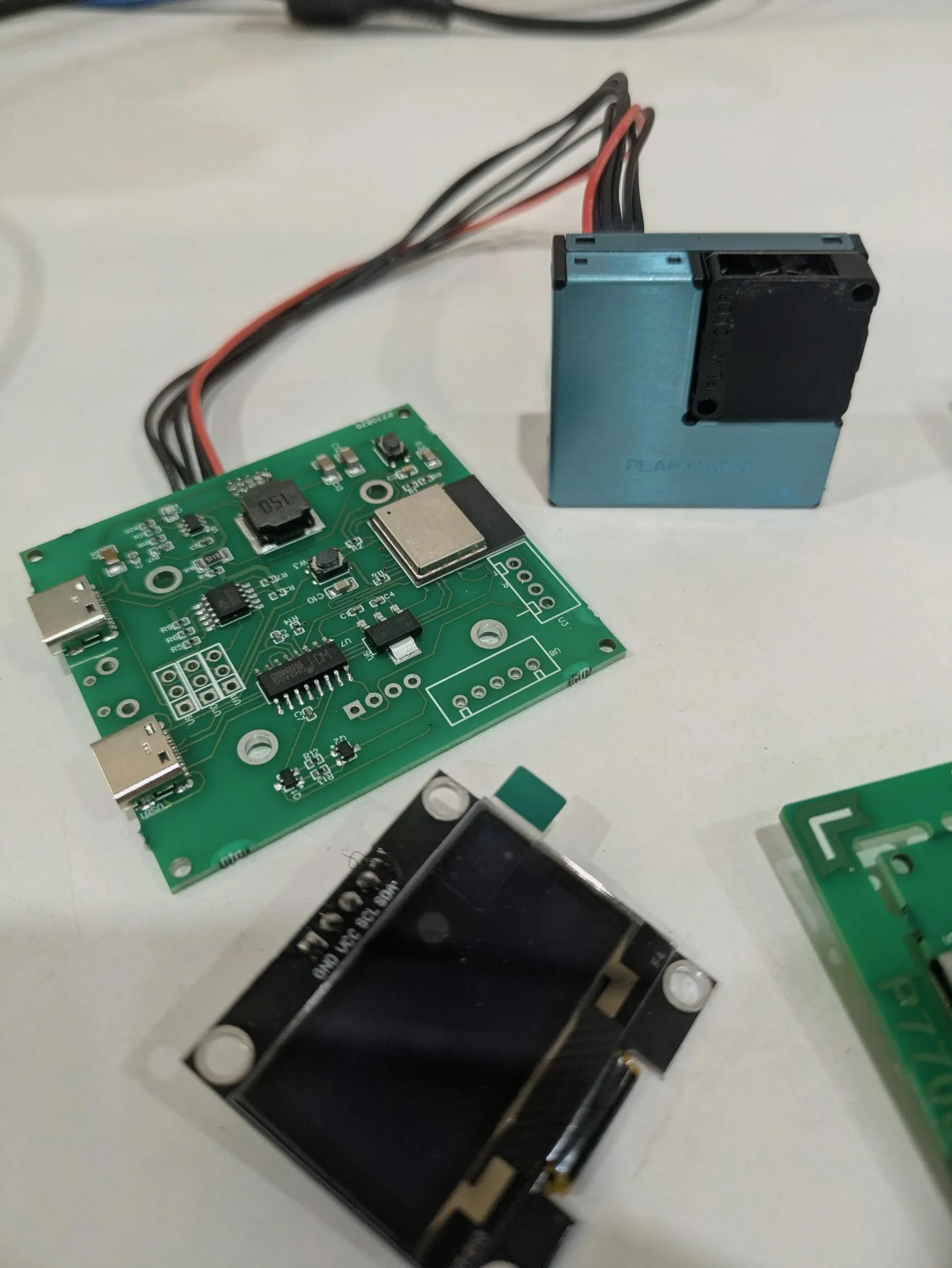
We designed the custom PCB to integrate everything the device needed on a single board — no jumper wires, no dev-board stacking. The design includes:
- 1Power management
Dual USB-C input with a buck converter stepping down to regulated 3.3 V for the ESP32-C3 and OLED, and 5 V pass-through for the Plantower sensor.
- 2Sensor interface
Dedicated UART lines and power management for the Plantower sensor, including the sleep/wake control pin so firmware can duty-cycle the sensor to extend its operational life.
- 3OLED driver circuit
I2C-connected OLED display interface, with pull-up resistors and layout considerations to keep the I2C bus clean at the operating frequency.
- 4Programming and debug headers
UART programming header for firmware flashing in production, with appropriate protection so it can be populated or depopulated depending on manufacturing stage.
The Solution: Firmware & Cloud
Firmware for this device covers four distinct jobs: read the sensor, calculate AQI, drive the display, and push data to the cloud. Our PCB design and firmware team handled all of it in ESP-IDF, keeping the code straightforward and deterministic.
Sensor Reading and AQI Calculation
The Plantower PMS sensor streams a structured data frame over UART at 9600 baud. Firmware parses the frame, validates the checksum, and extracts PM1, PM2.5, and PM10 concentration values. From the PM2.5 reading, we calculate the standard AQI index using the EPA breakpoint table — giving the device a clean, interpretable number that operators understand immediately, not just a raw µg/m³ reading.
OLED Display
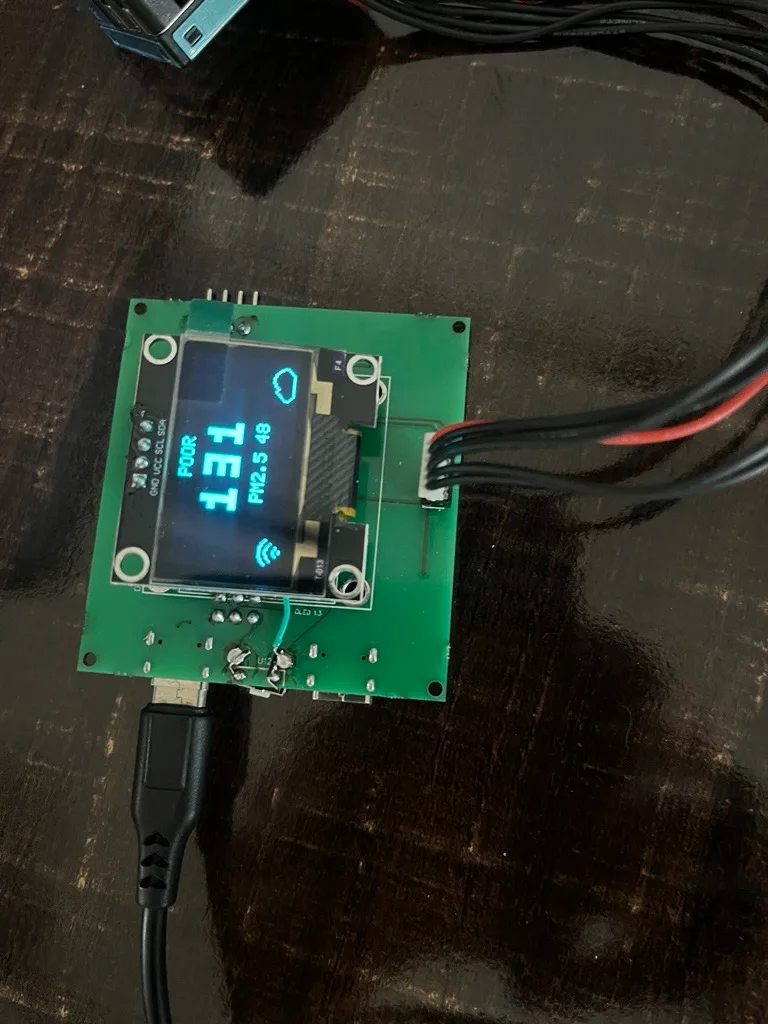
The 128×64 OLED shows the current PM2.5 concentration, calculated AQI value, and a qualitative label (Good / Moderate / Unhealthy / etc.) derived from the AQI breakpoints. Status indicators in the corner confirm live WiFi and MQTT connection state — so anyone looking at the device can immediately tell whether it's connected and reporting. The display updates on each new sensor reading.
WiFi and MQTT Publishing
On startup, the device connects to the configured WiFi network and establishes an MQTT session with the client's cloud broker. Readings publish on a structured topic at a configurable interval. The firmware handles reconnection automatically — if the broker drops or WiFi is lost, the device re-establishes the connection without operator intervention. The client's cloud dashboard receives a clean JSON payload with timestamp, PM values, and AQI on every cycle.
For our approach to connecting devices like this to cloud infrastructure, see our idea-to-MVP process — this project is a concrete example of how that process compresses into days rather than months when the hardware and firmware capability is already in-house.
Manufacturing & Validation
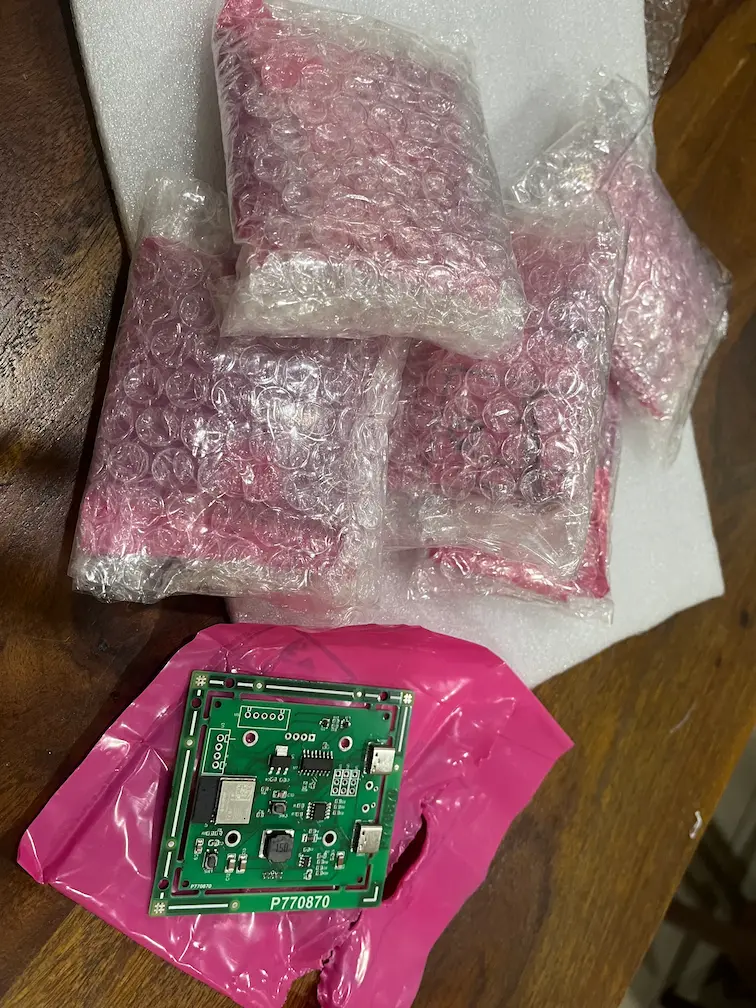
A prototype that only works in a lab is not what this client needed. Once the design was verified on bench, we moved to a fabricated PCB batch — real boards, not assembled dev-kit stacks. The initial run produced six units, with bulk production planned as the product launches commercially.
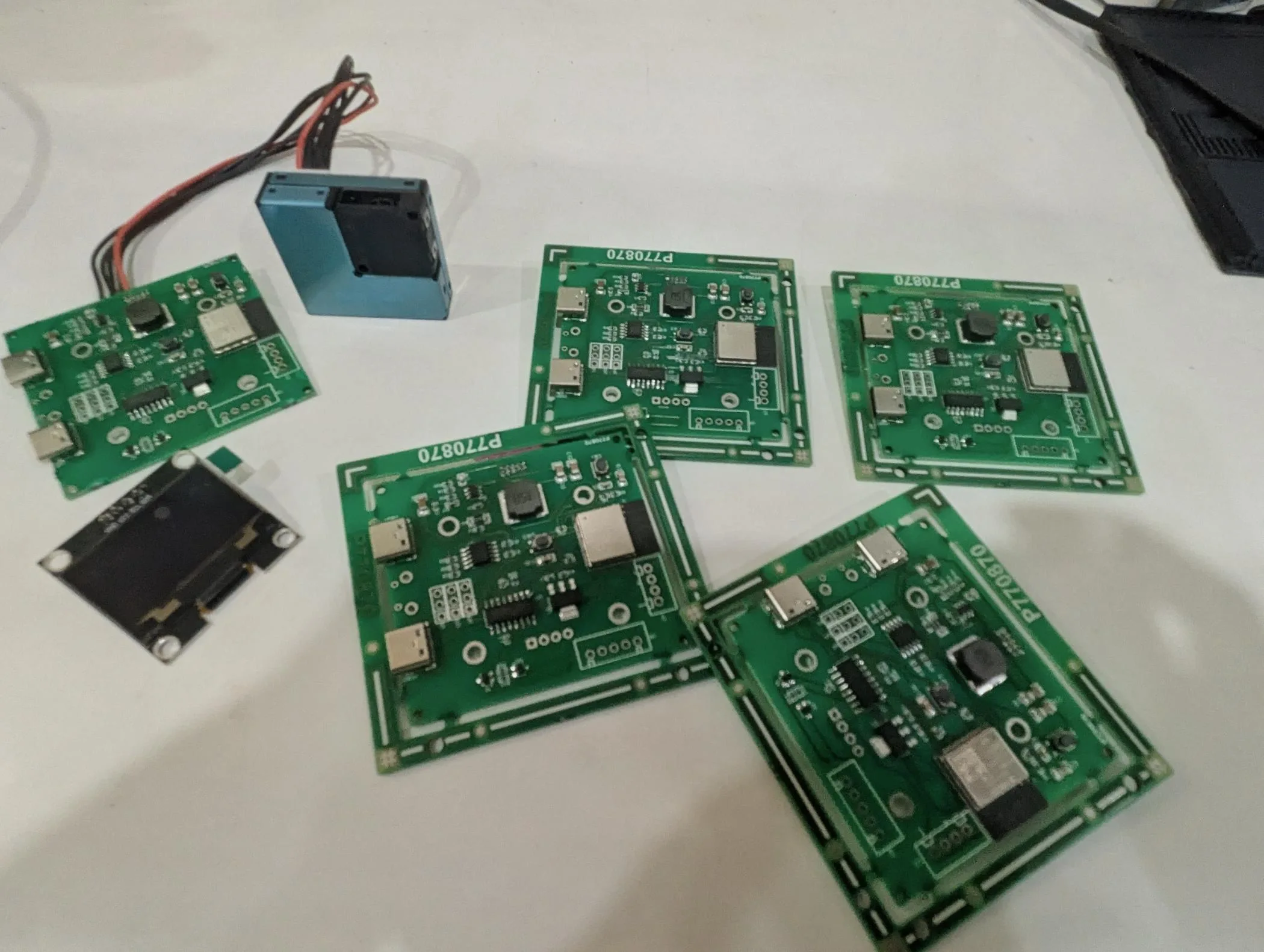
Fabricated board quality matters in a way that hand-assembled prototypes hide. Solder joints, trace integrity, component placement tolerances — these only reveal themselves on a properly manufactured board. Running the initial batch through our lab let us confirm the design holds up before the client commits to a larger production run.
Validation Results
- ✓Stable in high outdoor temperatures
Units were tested in elevated ambient temperatures representative of outdoor deployments. Power management and sensor performance remained stable throughout.
- ✓Accurate PM readings
PM2.5 readings cross-checked against reference instruments. AQI calculations match expected breakpoint outputs across the measurement range.
- ✓Reliable WiFi and MQTT connectivity
Devices maintain MQTT sessions and reconnect automatically after network interruptions. No manual reset required in any test scenario.
- ✓Display accurate and readable
OLED updates correctly on each sensor cycle. Status indicators reflect actual connection state in real time.
The Result
Working, validated units delivered in 16–18 days. A manufacturable PCB design the client owns outright. Firmware and cloud integration running reliably in real conditions. An initial batch of six units already fabricated, with bulk production ready to execute.
The client gets what they came for: their own branded air quality monitor. Their device, their data, their product roadmap. When they want to iterate — add a temperature sensor, adjust the AQI algorithm, change the display layout — they can, because they own the design.
The 16–18 day timeline wasn't luck. It was the result of having hardware and firmware capability in-house, under one roof, with no handoffs between a PCB designer, a separate firmware contractor, and a cloud integrator. Everything ran in parallel. That's the only way to move this fast without cutting corners.
Why DigitalMonk
What made this project run fast was the absence of handoffs. PCB design, firmware engineering, cloud integration, and manufacturing coordination all happen inside our team. When a hardware decision has firmware implications, we catch it before it costs a board revision. When the firmware needs a specific pin assignment, the schematic gets updated in the same conversation.
We've shipped IoT products — not just designed them. That experience shapes how we make decisions: we know which trade-offs bite you at volume, which sensor interfaces cause headaches in production, and how to design a PCB that a contract manufacturer can assemble without a field engineer on-site.
If you're building an IoT product and need a team that covers the full stack — from schematic to MQTT — take a look at what we do as an IoT development company. We work on fixed-scope product builds and longer-term embedded team engagements across India, the US, and the UK.
Custom PCB Design
Schematic, layout, BOM, and manufacturing files — designed for production, not just proof of concept
Embedded Firmware
ESP-IDF, FreeRTOS, Zephyr — firmware that ships and keeps running in the field
Cloud & Connectivity
MQTT, WiFi, BLE provisioning — devices that talk to your infrastructure, not ours
Manufacturing Coordination
From first batch to volume run — we manage fabrication so the client doesn't have to
DigitalMonk — IoT Development Company
Full-stack IoT development: hardware, firmware, cloud, manufacturing. We take products from idea to working units.
Frequently Asked Questions
Want Your Own Custom IoT Device?
Air quality, environmental monitoring, or otherwise — we design the hardware, write the firmware, connect the cloud, and get it manufacturing-ready. Let's talk about what you're building.
Get a Custom IoT Quote →