How Much Does ESP32 Product Development Cost in 2026?
A complete, no-fluff breakdown of what it actually costs to take an ESP32-based product from idea to production in 2026 — firmware, PCB, prototyping, cloud, mobile app, and everything in between. Agency vs freelancer vs in-house compared.


Why ESP32 Development Costs Vary So Much
If you have tried searching for ESP32 development costs online, you have likely seen answers ranging from a few hundred dollars to over $100,000. Both are technically correct — and equally useless without context. The variation comes from the fundamental difference between a hobbyist proof-of-concept and a production-grade commercial product.
An ESP32 devkit with a temperature sensor and a basic MQTT connection can be wired together in a weekend. A production ESP32 product — one that runs reliably in the field, receives OTA updates, integrates with a cloud backend, ships with a companion mobile app, and has gone through EMC certification — is an entirely different engineering challenge.
At DigitalMonk, our IoT development team has built ESP32-based products across retail, industrial, fitness, and smart infrastructure sectors. This guide is based on real project data — not guesswork.
The honest baseline: A minimum viable ESP32 product ready for field deployment — custom firmware, basic PCB, one prototype batch, and a simple cloud dashboard — will realistically cost between $4,000 and $10,000 with a credible development partner. Budget products built on Fiverr or $15/hr freelancers will cost more in the long run through bugs, rework, and unreliable hardware.
Firmware Development Cost
Firmware is the soul of your ESP32 product. It is the most labour-intensive component of development and also the one where quality differences are least visible until something breaks in production.
Basic Firmware — Single Function Device
Simple sensor reading, WiFi connectivity, MQTT or HTTP data push to a cloud endpoint. No OTA, no power management, no complex state machine. Suitable for proof of concept or very simple data loggers.
$400 – $1,250Mid-Complexity Firmware — Multi-feature Device
Multiple sensors, BLE + WiFi dual stack, FreeRTOS task management, basic OTA update support, persistent configuration storage, error handling and watchdog recovery. This is the baseline for a shippable consumer IoT product.
$1,250 – $4,000Production-Grade Firmware — Commercial Deployment
Full OTA pipeline, remote diagnostics, signed firmware binaries, fleet management hooks, power optimisation (deep sleep cycles, adaptive connection intervals), manufacturing test mode, and comprehensive error logging. Required for any product that will be deployed at scale and maintained in the field.
$4,000 – $12,500Edge AI + Advanced Protocol Firmware
On-device inference with TensorFlow Lite, custom protocol stack implementation, ESP-Mesh networking, Matter/Thread support, or integration with industrial protocols like Modbus or CANbus. This is specialist territory that requires engineers with both embedded systems and ML expertise.
$7,500 – $20,000+What drives firmware costs up: BLE mesh networking, custom over-the-air update pipelines, power management for battery-powered devices, integration with unusual hardware peripherals, and especially — any form of on-device ML or edge AI. If you need any of these, plan your budget accordingly and work with a specialist ESP32 development team from the start.
PCB Design Cost
PCB design for ESP32 products ranges from straightforward breakout expansions to dense, multi-layer boards with RF considerations, power management ICs, and antenna design. The choice between using an ESP32 module (like ESP-WROOM-32) versus a bare chip design alone can shift costs significantly.
2-Layer Simple Board
Standard ESP32 module, basic peripherals, single power rail, no high-frequency signals. Ideal for simple IoT sensors and data loggers. Fast turnaround.
4-Layer Mixed Signal Board
Separate analog/digital planes, multiple power domains, regulated supplies, controlled impedance traces for RF paths. Standard for consumer IoT products.
Custom Antenna + RF Design
PCB trace antenna design, RF matching networks, coexistence for WiFi + BLE, shielding requirements, pre-certification layout constraints. Required for FCC/CE.
Battery-Optimised Design
LiPo / LiFePO4 charging circuits, fuel gauging, ultra-low power standby design, DC-DC converters, thermal management for sustained discharge. Critical for wearables and field sensors.
⚠️ PCB fabrication is separate from design. For prototypes (5–10 boards), fabrication at JLCPCB or PCBWay typically costs $25–$150 depending on layers and complexity. Assembly (PCBA) adds $100–$400 for a prototype batch. For first production runs of 100–500 units, total fabrication + assembly costs typically run $1,000–$7,500 depending on component sourcing.
Prototyping Cost
Prototyping for ESP32 products goes through predictable phases. Each phase has different goals, different costs, and different failure modes. Trying to skip phases is the number one cause of expensive rework.
| Prototype Phase | Purpose | Typical Cost | Timeline | Risk Level |
|---|---|---|---|---|
| Breadboard / Devkit PoC | Validate core concept and sensor integration | $100 – $400 | 1–2 weeks | Low |
| Alpha PCB (Rev 1) | First custom board — expect hardware bugs | $750 – $2,000 | 3–5 weeks | Medium |
| Beta PCB (Rev 2–3) | Iterate on hardware + firmware together | $500 – $1,500 per spin | 2–4 weeks/spin | Medium |
| EVT (Engineering Validation) | Validate design meets all specs | $1,500 – $4,000 | 4–6 weeks | Medium |
| DVT (Design Validation) | Pre-production validation, DFM sign-off | $2,500 – $7,500 | 6–10 weeks | Low |
| PVT (Production Validation) | Trial production run, test yield | $4,000 – $12,500 | 8–12 weeks | Low |
Most startup ESP32 products reach production after 2–3 hardware spins. Budget for at minimum three PCB revisions in your planning. Experienced hardware teams can often reach production quality in fewer spins, which is why the hourly rate of a senior PCB designer is often cheaper in total than a lower-cost designer who requires more revisions.
Enclosure design — if your product needs a custom housing — adds another $1,500–$7,500 for industrial design and mould tooling, and is outside the scope of this guide. 3D-printed enclosures for prototypes cost $50–$250 and are fine for early validation.
Cloud Integration Cost
Most ESP32 products need some form of cloud backend — even if it is just device telemetry storage and a simple dashboard. The complexity varies enormously depending on how many devices you deploy, what data they generate, and what your end users need to do with that data.
Basic MQTT / HTTP Backend
Simple data ingestion via MQTT broker or REST API. Device data stored in a time-series database. Basic admin dashboard. Suitable for internal tools or small fleets under 100 devices.
AWS IoT / GCP IoT Core
Managed cloud IoT platform with device registry, policy management, rule engine, and integration with analytics services. Good for products scaling to thousands of devices.
OTA Update Infrastructure
Firmware hosting, versioning, staged rollout management, device authentication, and update monitoring dashboard. Essential for any commercial ESP32 product deployed in the field.
Full IoT Platform (Custom)
Multi-tenant architecture, user and fleet management, analytics and alerting, billing integration, white-labelling, API for third-party integrations. For companies building IoT as a SaaS product.
Cloud infrastructure running costs are often overlooked in initial budgets. For a fleet of 500 ESP32 devices reporting data every 5 minutes, expect AWS IoT Core costs of $50–$200/month. At 5,000 devices, this scales to $500–$2,000/month. Architect your data model and reporting frequency carefully — unnecessary data frequency is one of the easiest ways to inflate cloud costs. Our IoT development team in India always designs for cost-efficient data pipelines from the start.
Mobile App Development Cost
Most consumer-facing ESP32 products need a companion mobile app — for initial device setup via BLE, for real-time monitoring, or for configuration. Mobile development is often the single largest cost component in an ESP32 product budget.
| App Type | Features | iOS Only | Android Only | Cross-Platform (React Native / Flutter) |
|---|---|---|---|---|
| BLE Setup / Provisioning App | WiFi provisioning, device pairing, basic config | $1,500 – $4,000 | $1,500 – $3,500 | $2,500 – $5,000 |
| Device Monitoring App | Live telemetry, charts, notifications | $4,000 – $9,000 | $3,500 – $8,000 | $5,000 – $10,000 |
| Full Control + Config App | Provisioning + monitoring + full device control | $7,500 – $17,500 | $6,500 – $15,000 | $9,000 – $17,500 |
| Multi-device Fleet App | Fleet management, user roles, analytics | $12,500 – $30,000 | $11,000 – $27,500 | $15,000 – $30,000 |
BLE Integration Adds Complexity
Mobile apps that interact with ESP32 devices over Bluetooth Low Energy are significantly more complex to build than standard apps. BLE stack behaviour varies across Android manufacturers, iOS versions require specific permission handling, and connection reliability debugging requires real hardware. Plan for BLE-specific work to add 30–50% to a standard app estimate.
Cross-platform frameworks like React Native and Flutter are cost-effective when targeting both iOS and Android simultaneously, but BLE libraries in cross-platform environments are less mature than native. For BLE-heavy applications, native development often results in a more reliable product despite higher initial cost.
Full ESP32 Development Cost Breakdown 2026
The table below consolidates all five cost components with low, mid, and production-grade ranges. Use this as a starting point for your budget planning.
| Cost Component | Minimal / PoC | Standard Product | Production-Grade | Primary Driver |
|---|---|---|---|---|
| Firmware Development | $400 – $1,250 | $1,250 – $4,000 | $4,000 – $12,500 | Feature complexity |
| PCB Design | $400 – $1,250 | $1,250 – $3,500 | $2,500 – $7,500 | Layer count + RF |
| Prototyping (all spins) | $750 – $2,000 | $2,000 – $6,000 | $6,000 – $15,000 | Number of revisions |
| Cloud Integration | $750 – $2,500 | $2,500 – $9,000 | $9,000 – $30,000 | Scale + features |
| Mobile App | $1,500 – $4,000 | $4,000 – $10,000 | $10,000 – $30,000 | Platform + BLE |
| Total Estimate | $3,800 – $11,000 | $11,000 – $32,500 | $31,500 – $95,000 | Full scope |
⚠️ These are development costs only. They do not include FCC/CE certification ($2,500–$12,500), component procurement, production tooling, ongoing cloud infrastructure, app store fees, or post-launch support and maintenance. Always add 20–30% contingency to any embedded product budget for unexpected hardware rework.
Not Sure What Your ESP32 Project Will Cost?
Share your project scope with our engineering team for an honest, no-pressure estimate. We've built everything from simple sensor nodes to multi-location vending machine fleets on ESP32.
Hire an ESP32 DeveloperGet a Free EstimateAgency vs Freelancer vs In-House: Which is Right?
The hiring model you choose will affect your total cost, timeline, risk profile, and long-term ability to maintain the product. There is no universally correct answer — the right choice depends on your stage, budget, and product complexity.
Freelancer
Lowest UpfrontPlatforms: Upwork, Toptal, Fiverr Pro
- Lowest per-hour rate ($20–$80/hr)
- Good for narrow, well-defined tasks
- Fast to engage for small scopes
- Flexible contract terms
- Rarely covers firmware + PCB + cloud + app
- Availability gaps mid-project
- Limited accountability for production quality
- IP and NDA risks if not managed carefully
- Coordination overhead with multiple freelancers
Specialist Agency
Best ROIe.g. DigitalMonk — embedded IoT specialists
- Full stack: firmware, PCB, cloud, mobile
- Experienced team with embedded scar tissue
- Accountable for complete deliverable
- Structured process reduces rework
- NDA, IP assignment, proper contracts
- Ongoing support and maintenance available
- Higher rate than individual freelancers
- Minimum engagement size typically $2.5K+
In-House Team
Highest Long-TermFull-time embedded + cloud engineers
- Full control and IP ownership
- Deep product knowledge accumulates over time
- Best for products requiring continuous iteration
- Faster internal communication
- $80,000–$160,000/yr per engineer (US/UK)
- Recruitment takes 3–6 months for embedded roles
- You carry the HR and benefits overhead
- Team gaps if someone leaves
- Rarely justified unless you're scaling a team
| Factor | Freelancer | Specialist Agency | In-House |
|---|---|---|---|
| Typical Rate | $20 – $80/hr | $40 – $120/hr | $40 – $90/hr (fully loaded) |
| Full-Stack Coverage | Rare | Standard | Requires hiring |
| Accountability | Low | High | High |
| Time to Start | Days | 1–2 weeks | 3–6 months |
| Best For | Defined single tasks | Full product development | Scaling established products |
| Risk Level | High | Low–Medium | Medium |
Our recommendation for most hardware startups: Partner with a specialist ESP32 development agency for the initial product build, retaining IP rights and full documentation. Once you have a validated product and are scaling, bring the most critical functions — typically firmware maintenance — in-house while retaining your agency for new feature development and hardware revisions.
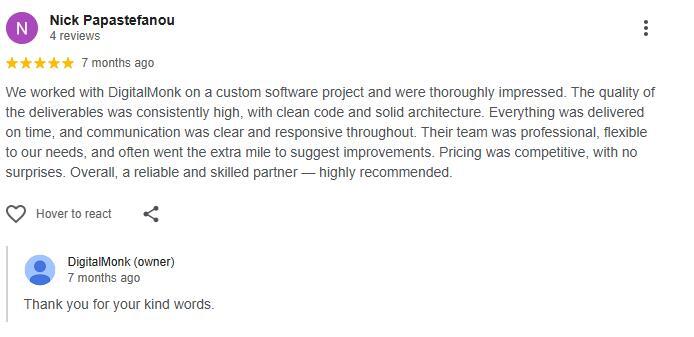
What Clients Say About DigitalMonk
Building an ESP32 Product? Let's Talk Numbers.
DigitalMonk is a specialist IoT development company that has shipped ESP32 products to Jersey Airport, the US fitness market, and industrial deployments across 3 continents. Get a real scope estimate — no sales pitch.
Hire an ESP32 Developer →Our IoT CapabilitiesFrequently Asked Questions
The most common questions we get about ESP32 development costs.
A minimal viable ESP32 product — custom firmware, a simple 2-layer PCB, one prototype batch, and a basic cloud endpoint — will typically cost between $2,500 and $7,500 with a credible development partner. This assumes no mobile app and simple data logging functionality. Any meaningful commercial product with a cloud dashboard and mobile companion app will realistically start at $10,000–$15,000.
Freelancers have a lower hourly rate but rarely cover the full ESP32 product stack — firmware, PCB, cloud, and mobile are all separate specialisms. Coordinating multiple freelancers adds significant management overhead and risk. For full-product development, a specialist ESP32 development agency typically delivers better total value despite a higher per-hour rate, because fewer revisions are needed and the team is accountable for the complete product.
A minimal ESP32 product can reach functional prototype in 6–10 weeks. A full commercial product — custom PCB through production validation, with cloud backend and mobile app — typically takes 4–9 months. The primary schedule driver is hardware: PCB fabrication and assembly turnaround at contract manufacturers is 2–6 weeks per spin, and products usually require 2–3 spins.
For most products, mobile app development is the largest single cost line — particularly when BLE provisioning is required. For industrial or complex IoT products, cloud backend development can exceed mobile app costs. Firmware development cost depends heavily on complexity: a simple sensor product costs far less than an edge AI or multi-protocol mesh networking product. Prototyping across multiple PCB revisions also accumulates significant cost that is often underestimated.
Yes, if you are selling a wireless product in the US, FCC certification is mandatory. Using certified modules (like Espressif's ESP-WROOM-32E) gives you modular certification that covers the RF portion, but your final product still needs to pass FCC Part 15 Subpart B for unintentional radiators. Budget $1,500–$7,500 for the full certification process including lab testing. CE certification for the EU is similarly required and similarly priced.
Yes — through smart scoping. Use ESP32 modules rather than bare chips to reduce PCB complexity. Start with WiFi only if BLE is not essential for your MVP. Use managed cloud platforms (AWS IoT, Google Cloud IoT) rather than building custom backends. Consider a web app instead of a native mobile app for initial validation. Most importantly, clearly define your MVP scope before starting — scope changes mid-development are the primary cause of budget overruns in embedded projects. An experienced IoT development partner can help you scope correctly from day one.
The ESP32-S3 adds AI acceleration instructions and USB OTG support vs the standard ESP32. From a development cost perspective, the firmware difference is marginal unless you are specifically implementing neural network inference on-device. PCB cost is essentially the same as both are available in similar module form factors. The ESP32-S3 is worth choosing if your product roadmap includes edge AI features, even if you are not implementing them initially, as retrofitting hardware later is expensive.
Prepare a brief that covers: what the device does, what data it collects and sends, how users interact with it, what connectivity is needed, target production volume, and any regulatory or certification requirements. With this information, a good development partner can give you a realistic scope and estimate in one or two conversations. Vague briefs produce vague (and usually wrong) estimates. Our team at DigitalMonk offers free project scoping consultations — NDA signed before we discuss anything.
Build Your ESP32 Product With a Team That Has Done It Before
ESP32 product development done right — firmware that runs in the field, PCB designed for manufacture, cloud that scales, and a mobile app your users will actually use. No guesswork. Real engineers. NDA from day one.