Custom Equine Performance Wearable — Real-Time Gait & Motion Tracking
A horse in training generates a huge amount of information a rider can only partly feel and a coach can only partly see. How long was the animal actually standing versus working? How much time was spent at trot? Did it break into a full racing gait when it was supposed to be recovering? Owners and trainers make real decisions — workload, rest, competition readiness — on the basis of that information, and most of it never gets recorded. A client came to us wanting to change that: a small, rugged wearable that could sit on a horse, recognise what the animal was doing, and report it in real time, without a rider needing to interpret anything.
We took the project end to end — from choosing the right hardware platform, through the on-device motion classification and the Bluetooth companion app, to the physical enclosure and strap that survive a working animal. This case study walks through how the product came together, the engineering decisions behind it, and where the honest limits sit.


The Challenge
The brief was deceptively simple: put a device on a horse and know what the horse is doing. The difficulty is in every word of that sentence.
A horse is a large, powerful, unpredictable animal. Whatever we mounted had to be light enough not to bother it, secure enough not to shift or fall off during vigorous movement, and enclosed well enough to shrug off dust, sweat, and knocks. It also had to run for days between charges — a device that needs daily attention is a device that gets left on the shelf. And the output had to be immediately legible: not a stream of raw sensor numbers, but a plain answer — standing, walking, trot, racing — that a trainer could read at a glance.
Those requirements pull against each other. Longer battery life wants a bigger cell, which adds weight and bulk. Richer motion analysis wants more processing, which drains the battery. Getting all of it into something small enough to strap to a horse and forget about is the actual engineering problem.
What We Built
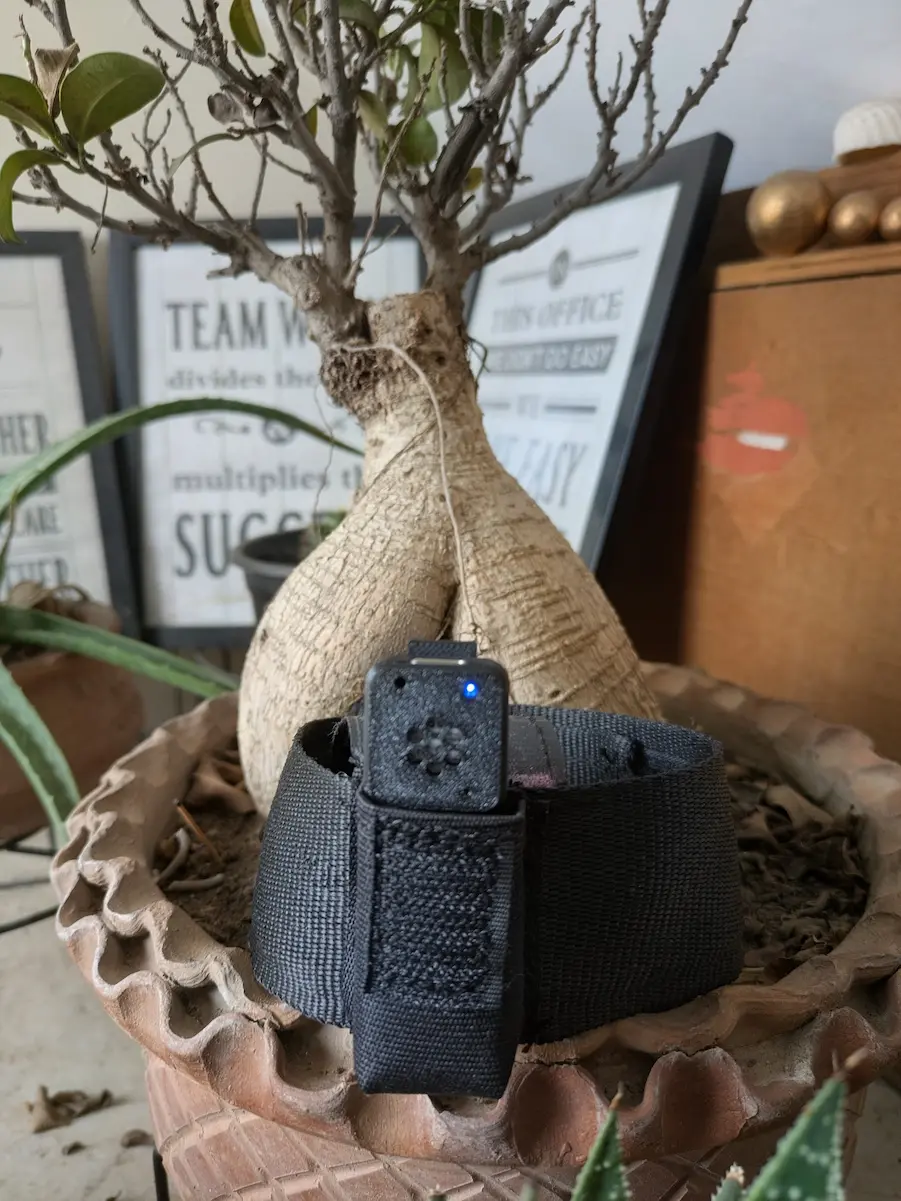
The result is a self-contained wearable that reads the horse's motion, decides what gait it corresponds to on the device itself, and broadcasts that result over Bluetooth to a companion app — all from a unit small enough to sit under a simple webbing strap.
The hardware
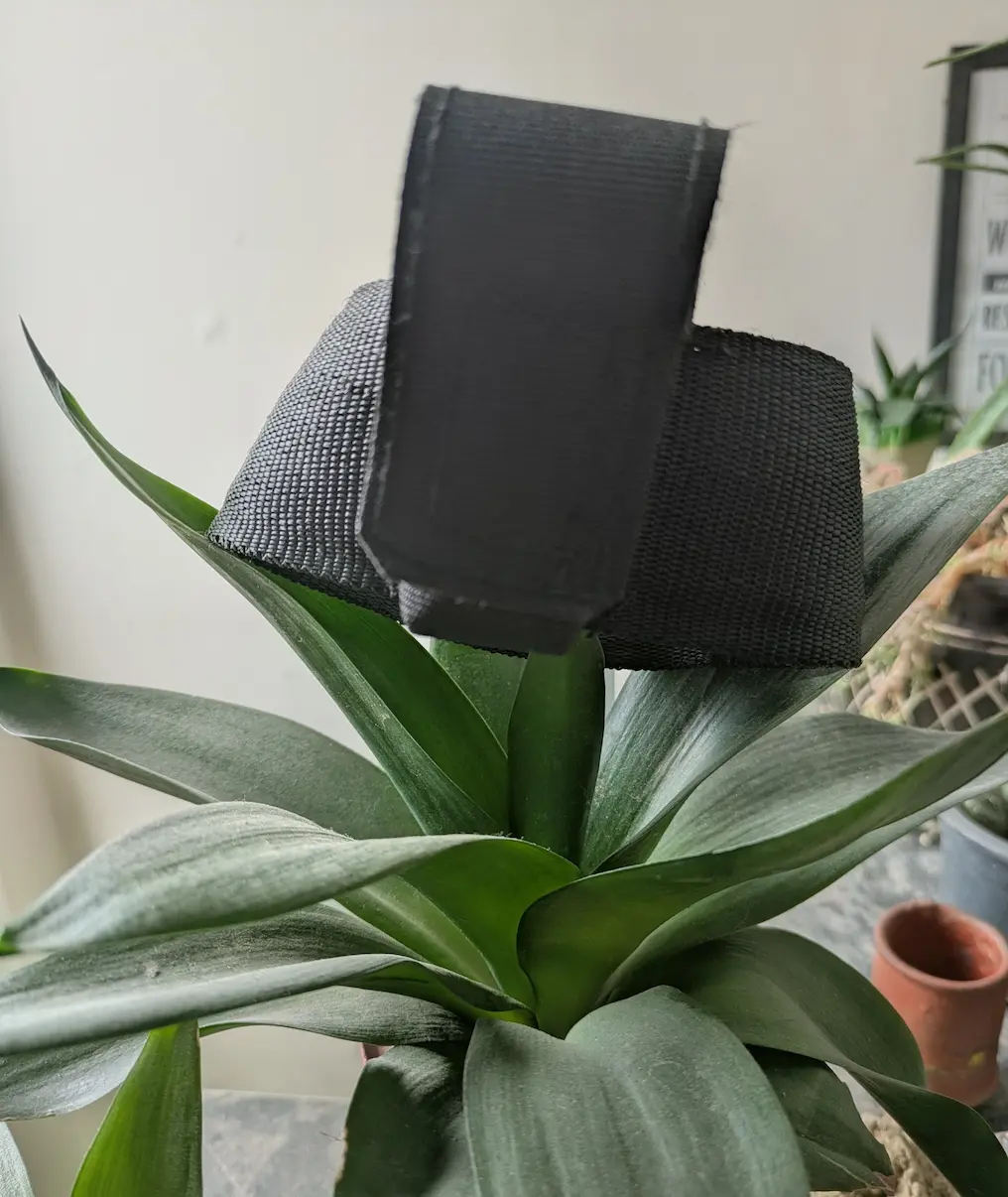
The electronics are built around a compact module with an onboard 6-axis inertial measurement unit — a combined accelerometer and gyroscope — housed in a 3D-printed enclosure sized to the strap. The IMU is the heart of the product: it senses acceleration and rotation across three axes, which is enough to characterise how the animal is moving moment to moment. A single rechargeable 500 mAh cell powers the unit, and the whole assembly is small and light enough to mount without interfering with the horse.
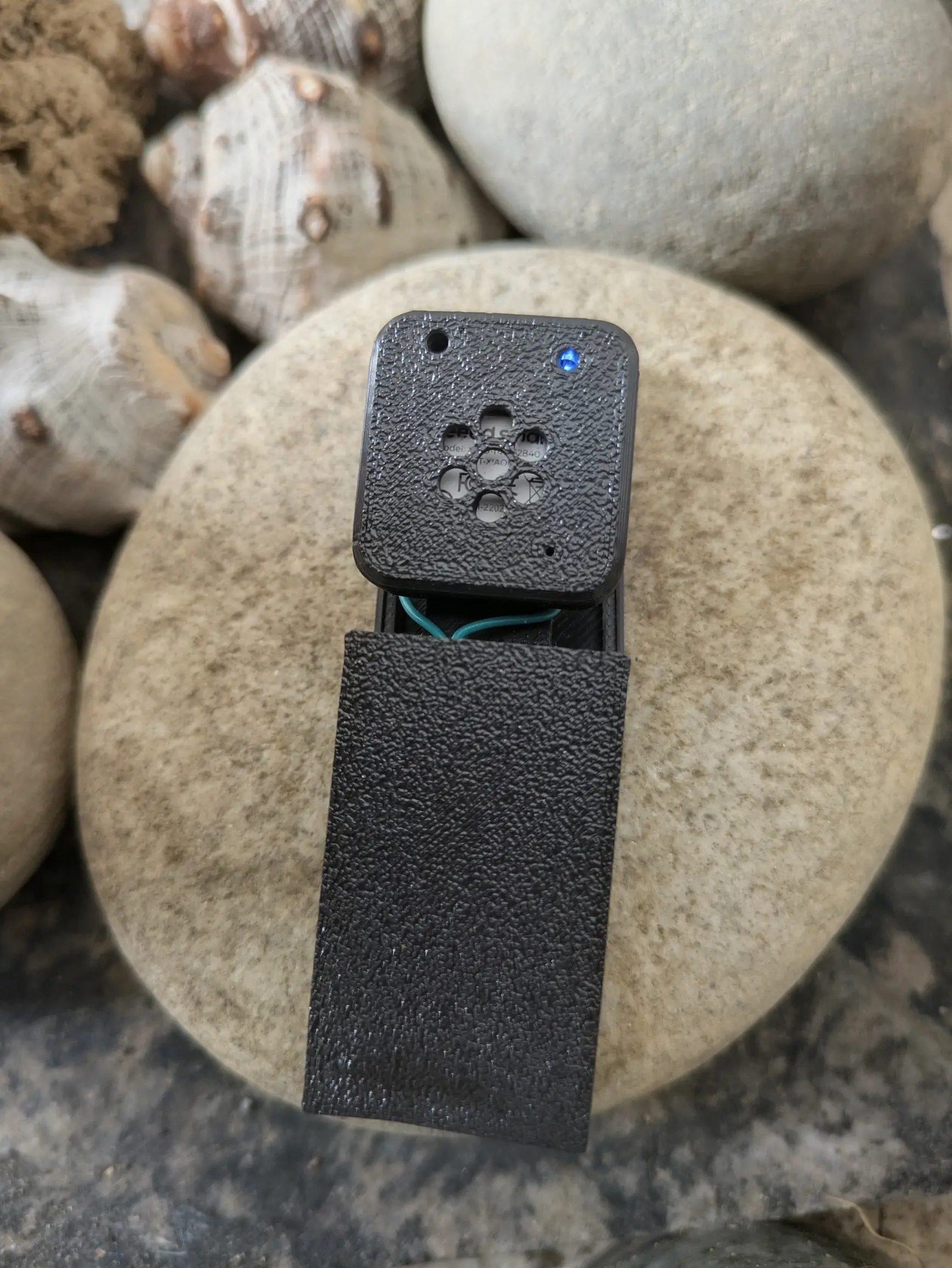
One decision is worth being candid about, because it shaped the whole product. We began development on an ESP32 — a capable and familiar platform. But when we measured real power draw against the multi-day battery target, the numbers didn't work: in our prototyping, the ESP32 build simply couldn't reach several days of runtime on a 500 mAh cell. Rather than paper over that with a bigger, heavier battery, we changed platforms. Moving to the Nordic-based module, with its far lower sleep current, is what actually made the 3-to-5-day runtime achievable. It cost us some rework, but it was the difference between a product that fits the brief and one that only looks like it does on paper.
The gap is a platform-level one, and it's visible in the published specifications for the two chips:
| ESP32 (deep sleep) | Nordic nRF52840 (System OFF) | |
|---|---|---|
| Datasheet sleep current (bare chip) | ~5–10 µA | ~0.4–1.5 µA |
| Practical draw on a small module | substantially higher, once the on-board regulator and USB bridge are counted | sub-µA to a few µA achievable |
| Result on a 500 mAh cell | couldn't reach the multi-day target in our build | 3–5 days between charges |
Sleep-current figures are from the published chip datasheets, not device-specific measurements; the runtime results are from our own prototyping.
The takeaway isn't that one chip is universally better — it's that for a always-worn, rarely-charged wearable, the sleep-current floor of the platform is the single spec that decides whether the product is usable, and it's the reason we switched.
Recognising gait on the device
The core capability is that the wearable interprets motion itself, rather than shipping raw data elsewhere to be processed. When the IMU detects that the horse is moving, the firmware examines the acceleration signature across the X, Y, and Z axes and classifies it into a state: standing, walking, trot, or racing. It also flags jumps as distinct motion events. Pace is derived from the acceleration data once motion is detected — an estimate of how hard the animal is working, read from the IMU rather than from GPS.
Doing this classification on the device, in firmware, is a deliberate choice. It keeps the data path short, avoids depending on a constant connection, and keeps power consumption down — the unit doesn't need to stream a firehose of raw samples to a phone and wait for an answer. The horse moves, the device decides, the label goes out.
The companion Mobile App and connectivity
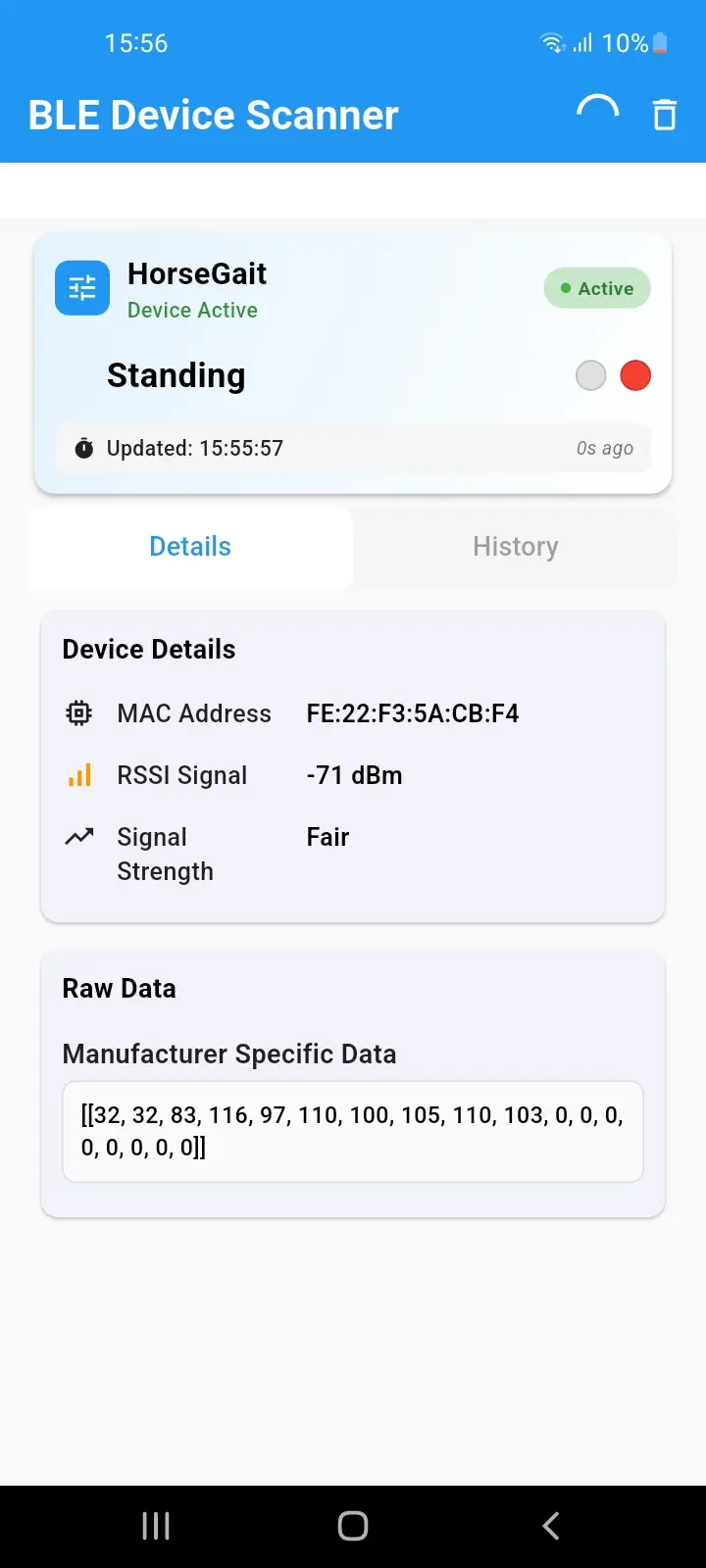
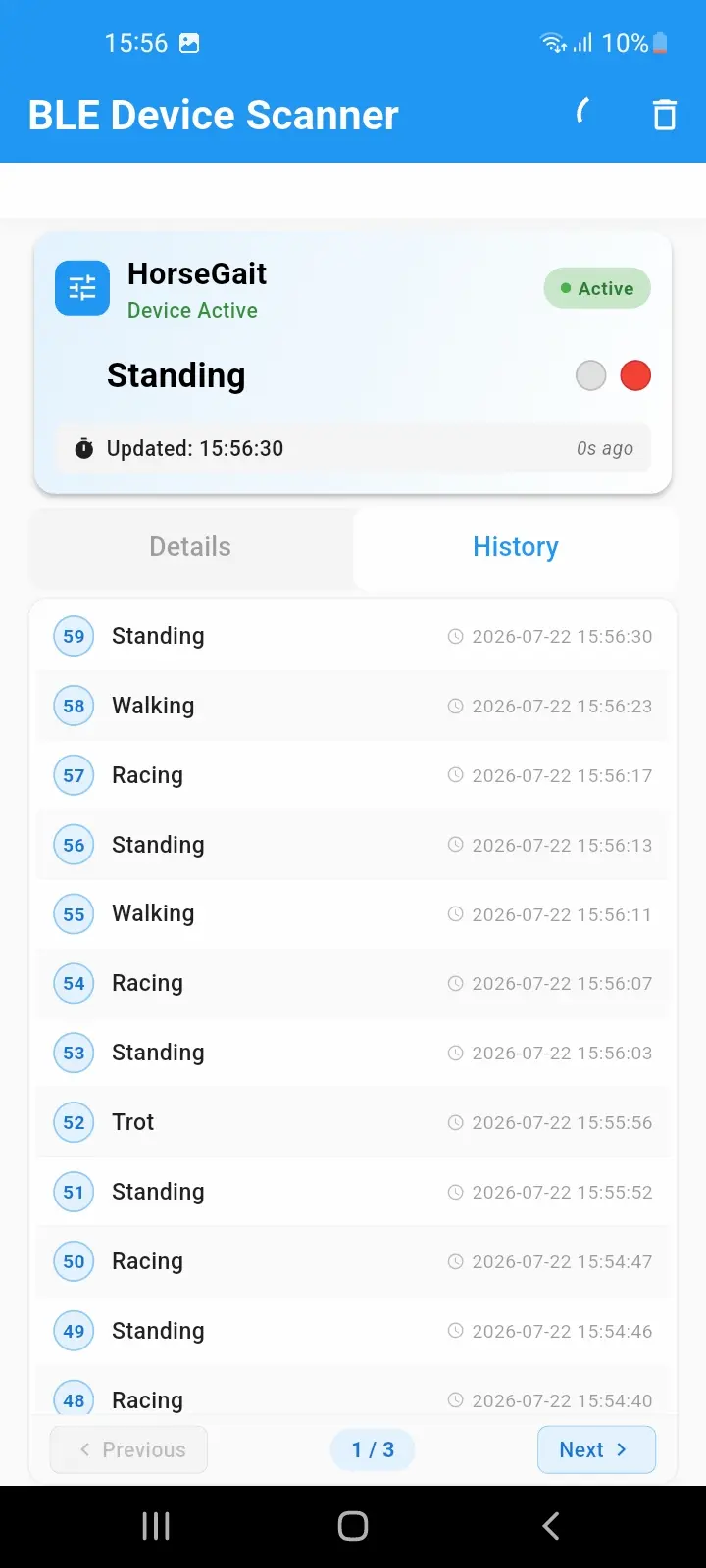
Getting the result off the device is handled over Bluetooth Low Energy, and we did it in a way that's lightweight by design. Instead of holding an open connection, the wearable encodes the current gait as plain text inside its BLE advertising packet — the small payload a Bluetooth device broadcasts to anything listening nearby. The companion Mobile App reads that broadcast, decodes the label, and displays the horse's current state live, alongside signal strength and device details.
The app also keeps a running history: each change of state is logged with a timestamp, so a trainer can scroll back through a session and see exactly when the horse was standing, when it was walking, when it broke into a trot, and when it was racing. That timeline — not any single instantaneous reading — is where the value sits for training and competition review.
Power and physical design
Everything above only matters if the device stays on the horse and stays charged. The 500 mAh cell, paired with the low-power platform and the on-device processing approach, delivers 3 to 5 days of use between charges, and recharges over a standard connection. The enclosure and webbing strap were designed to hold the unit firmly against a moving animal and take the inevitable knocks of a working environment. It's an unglamorous part of the job, but for a wearable it's half the product.
Challenges and How We Solved Them
The Outcome
The finished wearable does what the client asked for: strapped to a horse, it recognises the animal's gait in real time — standing, walking, trot, racing — flags jumps, estimates pace from motion, and streams a live, timestamped record to a companion app, all on a battery that lasts several days between charges. It's a complete, field-ready unit intended for training and competition use, where an objective record of how a horse actually spent its session is genuinely useful.
Why This Kind of Project Suits Us
This was a wearable problem before it was a horse problem. The hard parts — sensing motion accurately, classifying it on constrained hardware, moving results over Bluetooth without wrecking battery life, and packaging all of it into something that survives real-world use — are the same challenges in any performance-tracking wearable, whatever it's strapped to. The equestrian application is the specific use case here; the underlying capability is device design, embedded firmware, low-power engineering, and connected companion apps.
That's the work we do: taking a product idea through the entire development cycle to a working device. This one leaned heavily on firmware and low-power design on the Nordic platform , and sits within our broader electronics and embedded software development practice, alongside our sports tech product development work. If you have a wearable or connected-hardware idea that needs to become a real, shippable product, that end-to-end embedded product development path is exactly what we build.
Have a Wearable or Connected-Hardware Idea?
Whether you need a custom sensor wearable, on-device motion classification, or a BLE companion app, DigitalMonk can help turn your idea into a production-ready product.