Case Study: Interactive Retail Display with Timer & Anti-Theft Alert
Retail floors run into a persistent contradiction with display merchandise: customers want to pick a product up and handle it before they buy, but the moment an item leaves its stand, it can walk out the door. DigitalMonk was commissioned to solve this for one of the most-handled — and most-stolen — items in electronics retail: the video game controller. Each unit we built holds a controller in a moulded cavity in the enclosure, seated on a spring-backed load sensor. When a shopper lifts the controller to try it, an on-screen countdown starts. Return it in time and the display resets to its resting state; hold it too long and the screen flips to GAME OVER while a red indicator light on top of the unit blinks — cueing staff and discouraging walk-off. We delivered 50 of these units — designed, built, tested, packaged, and shipped as finished working hardware.


How the Unit Works
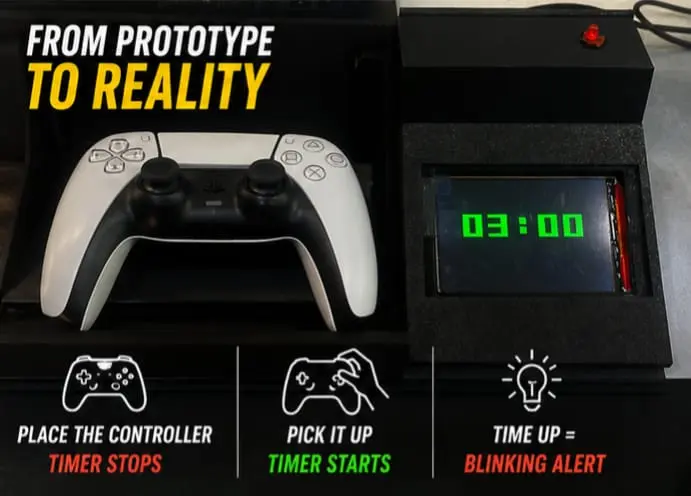
The interaction is deliberately simple, because it has to be understood by a shopper with no instructions. The controller sits in the display in a READY state. Picking it up starts the timer. Putting it back stops it. If the timer reaches zero before the controller is returned, the unit switches to its alert state — a blinking red light on top of the unit plus a GAME OVER message on the screen. There is no app for the customer to install and nothing for them to sign into. The entire behavior lives in the unit itself, driven by what the shopper physically does with the controller.
The Client's Challenge
Our client, Shahin, is a Canadian retail hardware integrator. He sources interactive fixtures and hardware and resells them to mall retailers across Canada, which meant the units had to arrive as finished, deployable products — not a reference design, and not a box of parts for someone else to assemble.
Off-the-shelf retail security hardware is built around tethers, alarms, and locked mounts. All of them defeat the point of a try-before-you-buy display: they stop the customer from freely handling the product. Shahin needed the opposite — hardware that invites handling but puts a soft, gamified boundary around it, so a controller can be picked up and tried without becoming an easy theft. Nothing generic on the market did that, which is why the unit had to be built from scratch around the specific behavior he wanted on the shelf.
The Build
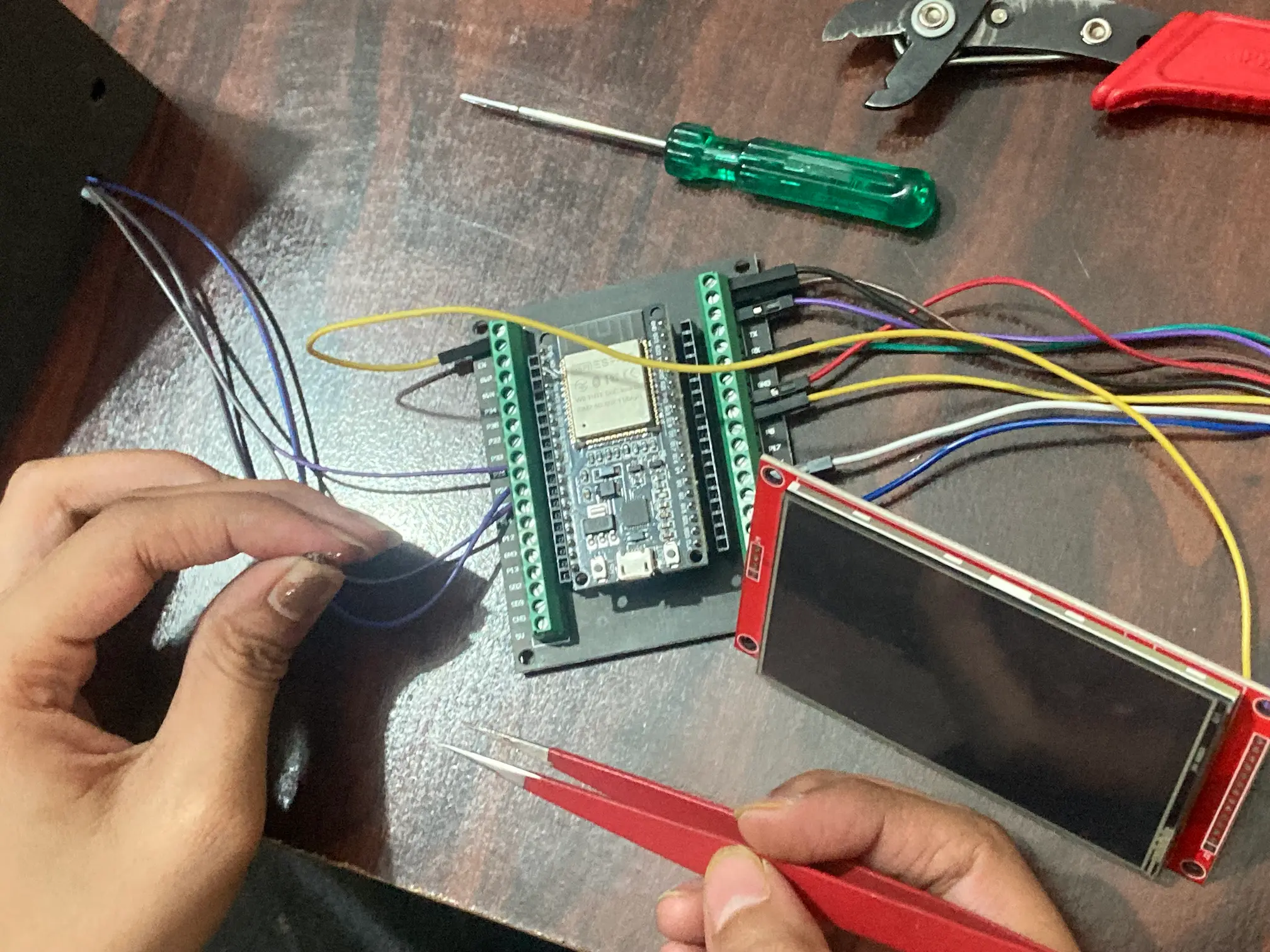
At the core of each unit is an ESP32, chosen for its processing headroom and its integrated Bluetooth radio, which the configuration step depends on. The display is a 3.5-inch TFT that carries the timer and the state messaging in text large enough to read across a retail aisle. Controller presence is sensed by a load cell read through an HX711 24-bit amplifier — the unit doesn't guess whether the controller is there, it weighs for it. A spring-backed cradle seats the controller consistently on the sensor, so the reading is repeatable no matter how a shopper drops it back in. The build was delivered on ESP32 by our developers.
Power was a real design consideration, not an afterthought. Each unit can run from its internal rechargeable battery over USB-C, or from a wired supply for permanent installations — the client isn't locked into one deployment style. Under normal retail use, a single charge lasts roughly two days.
One decision worth being candid about: we designed a custom PCB for the product, but did not fabricate it for this run. At 50 units, with no internal space constraint forcing a compact board, the tooling and setup cost of a fabricated PCB didn't earn its place — so we advised the client to ship on a module-based build that delivers identical behavior at the right economics for the batch size. Board design is part of what we do; knowing when it isn't worth spending on is part of the same job.
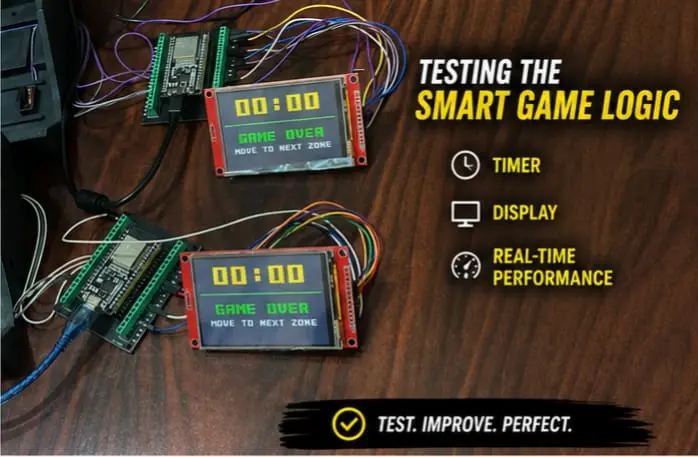
The firmware is a compact state machine: READY (controller seated, timer idle), COUNTDOWN (controller lifted, timer running live on screen), and GAME OVER (timer expired before return, blinking red top-mounted LED plus on-screen message). The load-sensor signal is filtered and debounced so a shopper adjusting their grip or resting the controller against the cavity edge doesn't false-trigger a transition — the difference between a unit that works in a demo and one that survives a busy shop floor.
Store staff set the allowed handling time per location over Bluetooth, using DigitalMonk's own BLE setup app. That keeps configuration in the hands of the retailer without any firmware reflashing per store, and lets the same hardware be tuned differently for a quick-try kiosk versus a longer hands-on demo. Owning both sides — the on-device firmware and the hardware integration behind it — is what made that configuration path clean rather than bolted on.
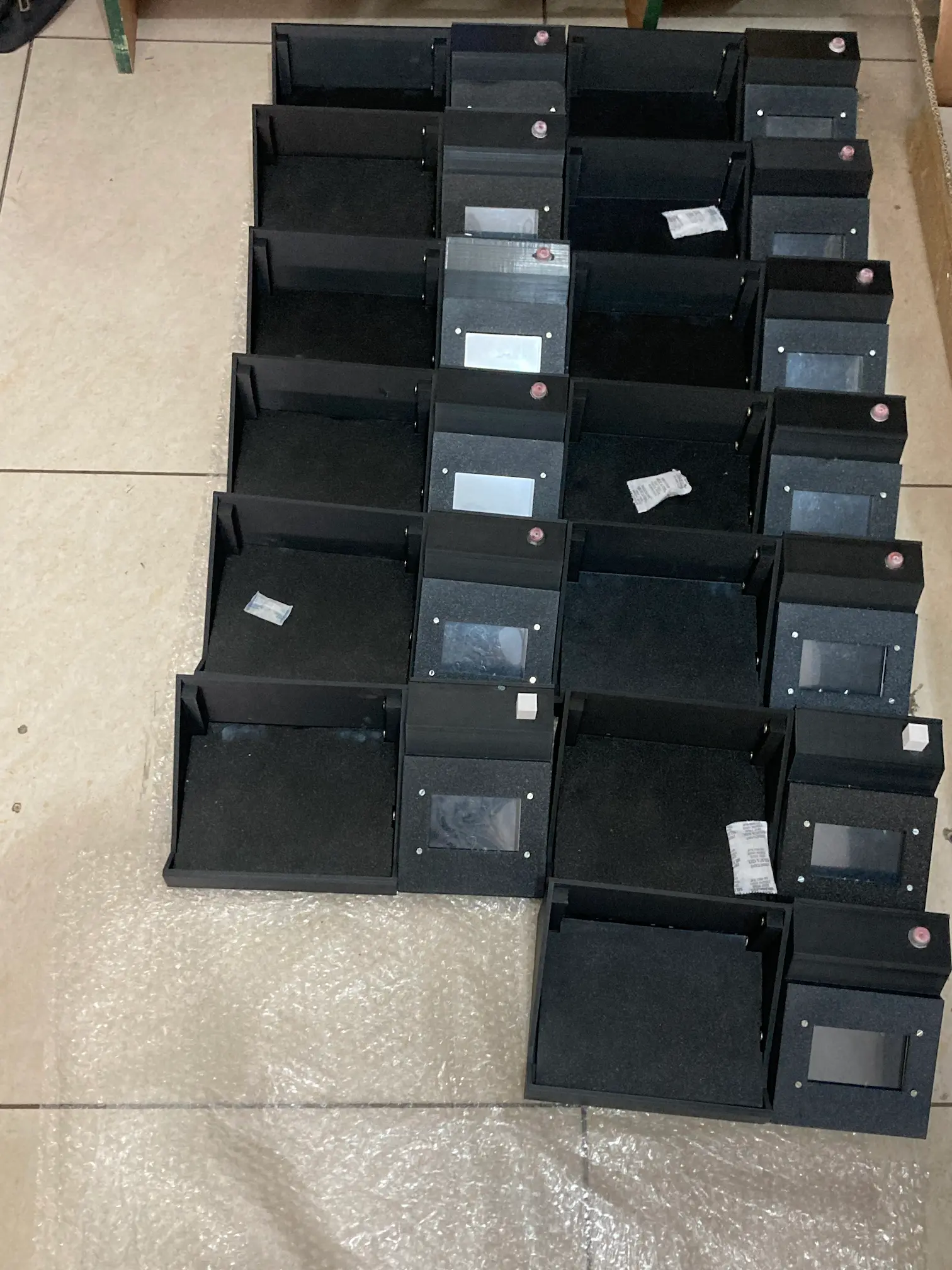
The enclosure was designed and produced in-house in our own lab, printed in PLA on Bambu Lab and Anycubic machines. It's more than a box: a moulded cavity cradles the controller on a spring-backed platform, presenting it at a natural pick-up angle and returning it cleanly to the same seated position each time, a cutout frames the screen, and the whole form was tuned for repeatable printing across the full batch — a shape that prints cleanly once is not the same as one that prints cleanly fifty times without babysitting. Doing the fabrication ourselves meant enclosure revisions happened on our own timeline instead of waiting on an outside shop.
Engineering Challenges We Worked Through
A few problems on this build were specific enough to be worth naming, because they're the difference between a unit that demos well and one that survives months on a shop floor.
Production and Delivery
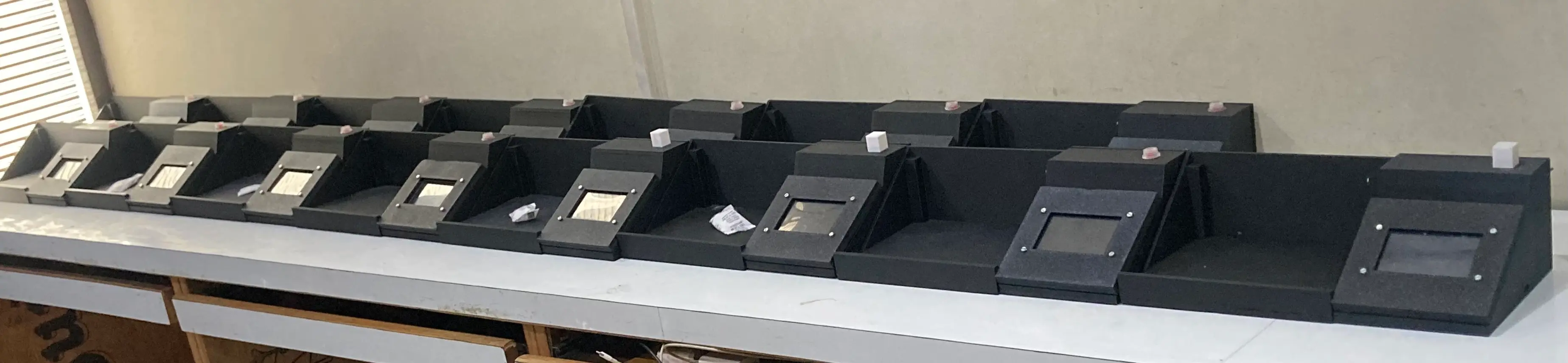
Fifty units is where a lot of "we can build hardware" claims quietly fall apart. Building one working prototype and building fifty that all behave identically are different disciplines. Each unit was assembled, flashed, and bench-tested individually before it was allowed into the packing line — the run of finished units on the workbench was as much a QA station as a production one.
Once the batch passed, the units were packed for international freight with protective wrapping and shipped to Canada, where all 50 were confirmed working on arrival — no dead-on-arrival units, no reflashing, no field repairs to get them running. That end-to-end path, from bare ESP32 modules to boxed hardware that works the moment it's unpacked on another continent, is the part our embedded electronics engineering team is built to own.
Outcome
The units are now deployed across multiple malls in Canada, and the relationship has continued past the first batch — Shahin has since ordered additional units, which is the clearest signal that the hardware holds up in the field and not just on the bench.
"The packaging was super professional and the look and fabrication quality is great. All 50 units perfectly working as expected."
— Shahin, Canadian retail hardware integrator
When Custom Retail Hardware Is Worth Building
Most retail hardware problems are solved with something off the shelf, and a good hardware partner will tell you when that's the right call. This project is a useful example of when it isn't.
The deciding factor here wasn't a feature — it was a behavior that didn't exist as a product. A timed, self-resetting deterrent that encourages handling instead of preventing it isn't a variant of a tethered display or an alarm tag; it's a different premise. Once the desired behavior can't be assembled from existing parts, custom becomes the only path, and the real question shifts to whether it can be built at a price and scale that make sense for the deployment — which is where small-batch electronics manufacturing sits.
A 50-unit run lives in an awkward middle. It's far too small to justify the tooling, minimum order quantities, and fixed setup costs of mass production, but far too large to hand-build one careful prototype and call it done. Getting it right means making deliberate choices about what to invest in and what to skip: a module-based build instead of a fabricated board, in-house 3D printing instead of injection-molded tooling, and per-unit bench testing instead of a sampled QA process. Those aren't compromises — at this volume they're the correct engineering economics, and choosing them well is a large part of what custom retail hardware development actually means at this scale.
For a reseller like Shahin, the payoff is a piece of hardware his competitors can't simply buy, delivered as working units he can put on a shelf and support — not a design he has to productize himself.
What This Proves
This is what end-to-end hardware delivery actually looks like: a problem defined on a retail floor, returned as 50 working units in a box. Sensing, firmware, power, enclosure, batch production, and packaging handled as one continuous job — the client received deployable hardware that worked on arrival, not source files, a prototype, or a design to hand off to someone else to finish.
Have a Custom Retail Hardware Idea?
Whether you need a custom sensor-driven fixture, a small-batch production run, or full ESP32 hardware and firmware development, DigitalMonk can help turn your idea into deployable, working hardware.